The Phú Mỹ Hưng apartment pink book is the certificate of residential property ownership issued by the State, establishing legal rights for buyers in the PMH urban area, District 7, Ho Chi Minh City. Most projects in this urban area have been fully issued with pink books, with a transparent legal commitment from the developer, Phu My Hung Development Corporation, over more than 30 years of operation. However, some projects still record delays in certificate issuance due to administrative procedural obstacles, meaning many buyers need to understand the legal status clearly before deciding to pay.
To obtain a pink book for a Phú Mỹ Hưng apartment, the buyer needs to prepare a dossier comprising the sale and purchase contract, the apartment handover record, the VAT invoice, the receipt for registration fee payment and valid personal documents. More importantly, under the 2023 Housing Law, the developer is obliged to submit the application for the pink book on the buyer’s behalf within 50 days of apartment handover, so buyers do not need to carry out this complex procedure themselves.
In addition, buying a Phú Mỹ Hưng apartment before the pink book has been issued can still be done under Article 33 of Circular 19/2016/TT-BXD, but it comes with notable legal limitations, such as the inability to mortgage it independently with a bank, difficulties in inheritance disputes and complete dependence on the developer’s progress in issuing certificates. In particular, the difference between a permanent-ownership pink book and a 50-year pink book is also a key factor affecting long-term asset value that every buyer needs to understand clearly before signing a contract.
To begin, the article below will comprehensively analyse the legal status of pink books for Phú Mỹ Hưng apartments, from definitions, conditions for issuance and procedures through to the risks to avoid, helping buyers understand every important aspect before making an investment decision.
What Is an Apartment Pink Book?
An apartment pink book is the Certificate of land use rights, ownership of housing and other assets attached to land, issued by the State to establish the legal rights of the apartment owner.
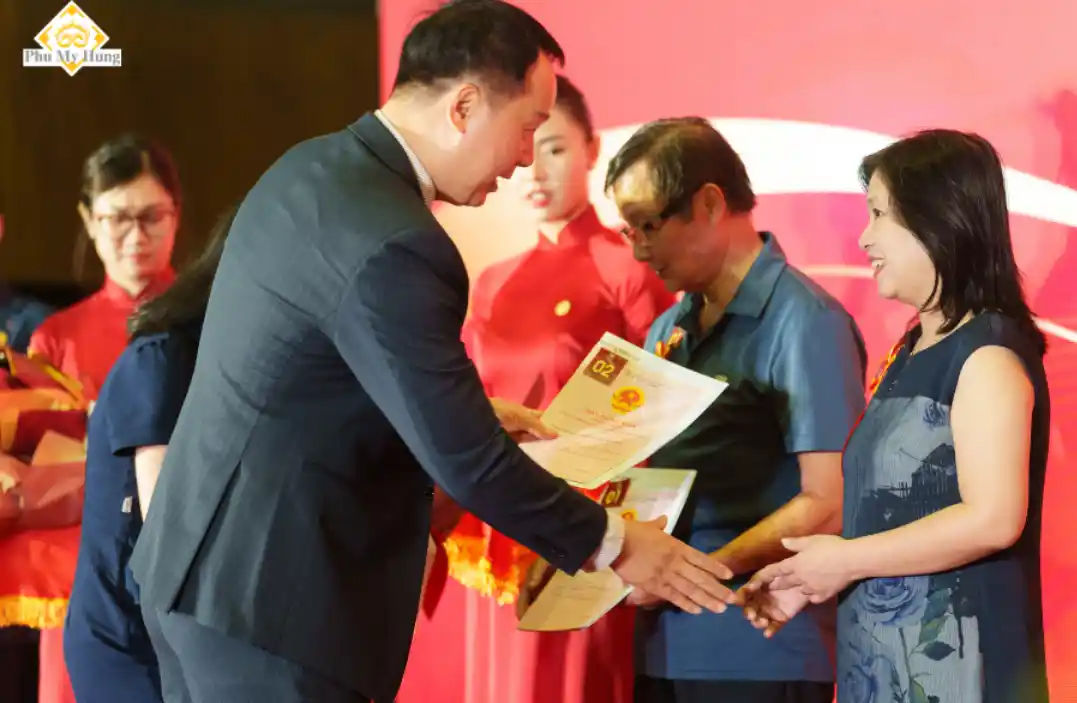
Specifically, this is the most important legal document for real estate buyers in Vietnam, commonly known as the “pink book” because of the certificate’s distinctive cover colour. Unlike the red book, which is used to establish land use rights for individual plots, the apartment pink book records ownership of the floor area within a multi-storey building, including both private usable area and the ownership share of common area as prescribed. Furthermore, the pink book is also the legal basis for carrying out important transactions such as sale, gift, inheritance, bank mortgage loans, or applying for permission to renovate the apartment interior.
On What Conditions Is a Phú Mỹ Hưng Apartment Pink Book Issued?
There are 2 main groups of conditions for issuing a Phú Mỹ Hưng apartment pink book: conditions on the developer’s side and conditions on the buyer’s side, met in accordance with the 2023 Housing Law and its implementing guidance documents.
Conditions on the developer’s side (Phu My Hung Development Corporation):
- The project must be completed and accepted by the competent authority, with a written confirmation that it is eligible to be put into use
- The developer must complete its financial obligations to the State, in particular paying land use fees in full in accordance with the tax authority’s decision
- The as-built drawings must be checked by the Department of Natural Resources and Environment and confirmed to match the actual construction
- The project must not be subject to legal disputes, distraint or mortgage of the entire project at a credit institution
Conditions on the buyer’s side:
- Full payment of the apartment sale contract value, including ancillary fees as agreed
- Completion of the registration fee tax obligation at the rate set by the regional Tax Department
- Provide all valid personal documents as required by the Land Registration Office
More importantly, the specific legal basis is Clause 8, Article 39 of the Housing Law 2023, which clearly stipulates the developer’s responsibility to proactively submit applications for pink books for all apartment buyers in the project, rather than leaving buyers to handle the entire procedure themselves.
How Long Is the Pink Book for a Phú Mỹ Hưng Apartment Valid?
The validity of the pink book for a Phú Mỹ Hưng apartment depends on the owner: Vietnamese citizens enjoy indefinite, long-term ownership, while foreign individuals and organisations may own for a maximum of 50 years under current regulations.
More specifically, the ownership term is shown on the pink book as follows:
For Vietnamese nationals, the term of use section on the pink book states “Long term”, meaning ownership is not limited by any time frame. Buyers have full rights to use, sell and bequeath the apartment indefinitely without needing to renew.
For foreign individuals and foreign organisations, the ownership term is clearly stated as 50 years from the date of issuance. After this period, owners may apply for a further extension of up to 50 years if they meet the conditions under the amended Housing Law.
However, it should be noted that the land use term of the entire project (usually 50 years from the date of investment approval) also indirectly affects long-term asset value. Buyers purchasing for investment should consider this factor carefully, particularly when comparing projects launched at different times in the development history of the Phú Mỹ Hưng urban area.
Do Phú Mỹ Hưng Apartments Have Pink Books?
Yes, the vast majority of apartments in the Phú Mỹ Hưng urban area already have full pink books, for 3 main reasons: the developer’s transparent legal track record of more than 30 years, many projects having completed the issuance procedures as confirmed by the state authorities, and the systematic legal documentation management process of Phu My Hung Development Corporation.
However, in practice a number of projects have still encountered difficulties in the pink book issuance process, notably Hung Phuc Premier with reports of delays lasting several years. This shows buyers should not assume that all PMH apartments already have pink books, but should proactively verify the legal status of each specific project before signing a contract. In particular, the PMH property market comprises many segments and projects launched at different stages of development, so the legal status is not uniform.
Which Projects in Phú Mỹ Hưng Have Been Granted Pink Books?
Many projects in Phú Mỹ Hưng have been granted full pink books, falling into 2 main groups: projects that are fully completed and projects still finalising their documentation.
The table below summarises the legal status of selected representative projects in the Phú Mỹ Hưng urban area, giving buyers an overview before looking into the details:
| Project | Pink book status | Notes |
| Sky Garden 1, 2, 3 | Pink book issued | Long-term ownership for Vietnamese nationals |
| Scenic Valley | Pink book issued | Complete legal status, high liquidity |
| Riverside Residence | Pink book issued | Pink books issued for most units |
| Midtown (M-One, M-Infinity) | Pink book issued | Lots handed over from 2018–2020 |
| Hưng Phúc Premier | Delayed issuance | Outstanding tax procedures, 137 applications submitted and pending |
| Plot CR8-2B (Tan My Ward) | Being processed | 76 apartments, with Certificates of Land Use Rights issued since 2012 |
Furthermore, to verify the legal status as accurately as possible, buyers should consult 2 official sources directly: the Ho Chi Minh City Land Registry Office (online via the information portal of the Ho Chi Minh City Department of Natural Resources and Environment) and in person at the Phu My Hung real estate sales centre at 801 Nguyen Van Linh, Tan Phu Ward, District 7.
Why Are Some Phu My Hung Apartments Slow to Receive Their Pink Books?
There are 3 main reasons why some Phu My Hung apartments are slow to receive their pink books: difficulties in determining financial obligations with the tax authorities, delays in inter-agency coordination between government bodies, and some cases involving internal disputes within the building.
Specifically, the procedure for issuing pink books in Ho Chi Minh City requires coordination between several authorities: the developer must submit the dossier to the Land Registry Office, which forwards it to the Sub-Department of Taxation to calculate the registration fee, after which the dossier is returned for processing and issuance of the book. Each step may take from several weeks to several months if administrative backlogs arise.
A typical example is the Hưng Phúc Premier case: after the Department of Agriculture and Environment confirmed that the project was eligible for pink books in December 2020, the developer submitted 137 dossiers to the Ho Chi Minh City Land Registry Office, but the transfer to the tax authority for registration-fee calculation was delayed, resulting in residents having to wait for an extended period.
More importantly, it is necessary to clearly distinguish between 2 types of delay in receiving pink books to avoid confusion when assessing risk:
- Delay due to administrative procedures: The project meets the legal requirements and the dossier is being processed within the system; buyers remain secure in terms of their actual ownership rights but are waiting for the official documents
- Delay due to legal disputes: The project has issues relating to land, land-use rights or an unreleased mortgage; this is a high-risk situation that should be avoided
What Steps Are Involved in Obtaining a Pink Book for a Phu My Hung Apartment?
The procedure for obtaining a pink book for a Phu My Hung apartment comprises 4 main steps: preparing the dossier, submitting it through the developer, the tax authority calculating the registration fee, and the Land Registry Office issuing the book, with the expected outcome being that the buyer receives a valid pink book within 50 to 90 working days.
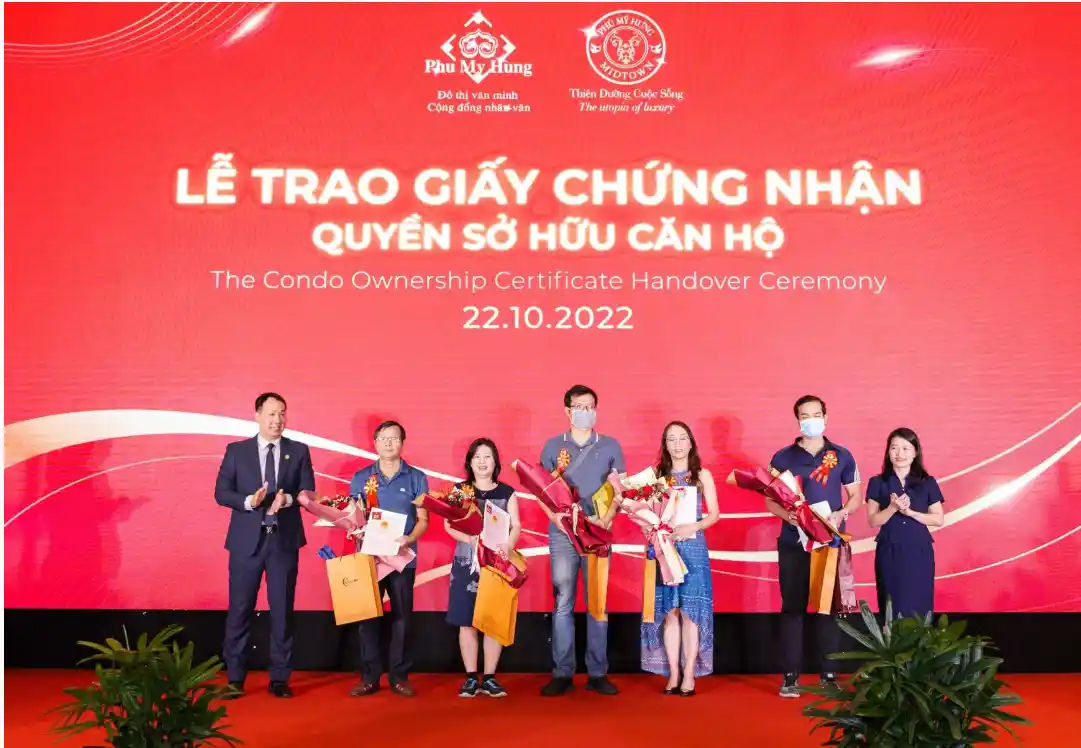
Below is an overview of the process from A to Z that Phu My Hung apartment buyers need to understand in order to proactively monitor progress and protect their rights:
Step 1 – Complete financial obligations: The buyer pays the full 100% of the purchase contract value, including management fees, handover fees and any additional charges (if applicable), in accordance with the payment schedule in the contract.
Step 2 – Take handover of the apartment: Sign the apartment handover record with the developer; this is an important milestone for calculating the 50-day period within which the developer must submit the application for issuance of the book under the 2023 Housing Law.
Step 3 – The developer submits the dossier: Phu My Hung Development Corporation compiles the dossiers for all apartments in the project and submits them to the Ho Chi Minh City Land Registry Office.
Step 4 – Registration-fee processing: The Land Registry Office forwards the dossier to the regional Sub-Department of Taxation to calculate and notify the amount of registration fee payable by the buyer.
Step 5 – The buyer pays the registration fee: After receiving the notification from the tax authority, the buyer pays the registration fee and obtains the confirmation receipt.
Step 6 – Receiving the pink book: Once the dossier is complete, the Land Registration Office issues the pink book and returns it through the developer or directly to the buyer, depending on each project.
Documents Required When Applying for a Phú Mỹ Hưng Apartment Pink Book
There are 2 groups of documents to prepare when applying for a Phú Mỹ Hưng apartment pink book: the project’s legal documents and the buyer’s personal documents, as required by the Ho Chi Minh City Land Registration Office.
Group 1 – Legal documents relating to the sale and purchase:
- Original apartment sale and purchase contract together with all attached appendices (original)
- Apartment handover record signed and confirmed by both parties (original)
- Contract liquidation record where required to complete the legal obligations
- Value-added tax (VAT) invoice proving valid payment
- Written confirmation of each transfer if the apartment has changed hands several times (01 notarised copy for each transfer)
Group 2 – Technical and project legal documents:
- As-built drawing or technical diagram of the apartment inspected and certified by the Department of Natural Resources and Environment
- Written confirmation of eligibility for use issued by the housing management authority
- Application for registration of changes to land and assets attached to land, using Form 11/ĐK issued together with Decree 101/2024/NĐ-CP
Group 3 – Buyer’s personal documents:
- Valid CMND or CCCD (notarised copy issued within the last 6 months)
- Permanent residence book or temporary residence registration document (notarised copy)
- Birth certificate and marriage certificate (if the apartment is jointly registered in the names of the husband and wife)
- Bank mortgage release document if the apartment is being used as security for a loan
Important note: All notarised copies must remain within the 6-month validity period for certified copies from the date the dossier is submitted. Submitting expired copies will result in the dossier being returned and extend the processing time.
Who Is Responsible for Submitting the Application for the Pink Book – The Developer or the Buyer?
The developer prevails in terms of default obligations under the law, while the buyer has the advantage of taking the initiative if they wish to handle the process themselves; co-operation between both parties is the optimal approach to ensuring progress and protecting their respective interests.
Specifically, under Clause 8, Article 39 of the 2023 Housing Law, the project developer has a mandatory legal responsibility to submit the application for the Certificate of land-use rights, ownership of housing and other assets attached to land on behalf of the buyer within 50 days from the date of handover of the apartment or from the date on which the buyer has made full payment under the contract. This is a mandatory obligation, not an option for the developer.
The comparison table below clarifies the rights and obligations of each party during the process of obtaining the certificate, helping buyers understand at which stage they need to take the initiative:
| Criteria | Developer (PMH) | Buyer |
| Legal responsibility | Must submit the application within 50 days | Provide all personal documents |
| Right to handle the process themselves | Not applicable | May handle the process themselves if the developer provides all the required documents |
| Financial obligations | Pay land-use fees and complete the completion procedures | Pay registration tax |
| Risks if the deadline is missed | Subject to administrative penalties in accordance with regulations | Not subject to penalties, but may lose practical benefits |
However, if buyers wish to handle the procedure for obtaining the certificate themselves instead of waiting for the developer, Phu My Hung Development Corporation is obliged to provide all the necessary project legal documents for buyers to complete the process. In this case, buyers submit their applications directly to the Ho Chi Minh City Land Registration Office, without the need to go through an intermediary.
Is It Risky to Buy a Phú Mỹ Hưng Apartment Without a Certificate?
Yes, buying a Phú Mỹ Hưng apartment before the certificate has been issued carries 3 main risks: limitations on independent financial transactions, complete dependence on the developer’s progress in obtaining the certificate, and the potential for legal disputes that are difficult to resolve in the absence of official ownership documents.
More specifically, when an apartment does not yet have a certificate, the buyer cannot independently mortgage the property to obtain a bank loan for their personal needs; all resale transactions must be carried out through the complex contract-assignment process at the PMH Real Estate Sales Centre; and determining inheritance rights and dividing family assets may present considerable legal difficulties. Conversely, an apartment with a certificate provides comprehensive legal protection, enabling buyers to take full control of all transactions.
How Does a Permanent-Ownership Pink Book Differ from a 50-Year Pink Book?
A permanent-ownership pink book is superior in long-term asset value and inheritance rights, a 50-year pink book is more suitable for foreign investors under the current legal framework, while opting for a permanent pink book is always the best priority for Vietnamese buyers purchasing for owner-occupation or long-term investment in Phú Mỹ Hưng. The key point is that the type of pink book directly affects the resale price, mortgageability and inheritance rights of the apartment, so buyers need to confirm the book type clearly from the contract negotiation stage.
What Should Be Noted When Transferring a Phú Mỹ Hưng Apartment Without a Pink Book?
Transferring a Phú Mỹ Hưng apartment without a pink book must follow 4 mandatory steps at the PMH Real Estate Sales Centre, pursuant to Article 33 of Circular 19/2016/TT-BXD, and both the seller and the buyer must carry out the transaction in person, with absolutely no authorisation of a third party permitted. The specific additional dossier includes a Request for Withdrawal/Postponement of the pink book application dossier (if the seller has already submitted it), a bank mortgage release letter if the apartment is mortgaged, and a written transfer confirmation from the developer issued within 7 working days. Resale buyers should require the seller to provide the original contract and the full transfer history to ensure an unbroken legal chain and avoid the risk of future disputes.