The pink book (sổ hồng) for Phú Mỹ Hưng shophouses is a certificate of permanent (freehold) ownership, not subject to the 50-year limit that applies to most shophouses on the market, and this is the core legal factor that any investor needs to verify carefully before committing funds. In particular, 100% of the shophouses in the Phú Mỹ Hưng urban area are covered by the developer’s commitment to issue a certificate of land use rights, ownership of housing and assets attached to land in accordance with Vietnamese law, with a directly signed sale contract and a bank guarantee.
To obtain the pink book for a Phú Mỹ Hưng shophouse, investors need to complete the application file for the certificate, comprising personal legal documents, the sale contract and tax payment receipts, and the developer Phú Mỹ Hưng will support the entire submission process with the competent authorities. The certificate is usually issued within 12 to 18 months from the date the two parties sign the sale contract and the shop is handed over.
More importantly, holding a pink book confirming long-term ownership in Phú Mỹ Hưng gives investors three strategic legal advantages: the property is eligible for a bank mortgage with a loan of up to 50% of the shophouse’s value; it is highly liquid when resold because the transfer procedure is quick; and its value increases sustainably over time thanks to a transparent legal basis. Below is the full detailed analysis to help investors understand correctly and verify fully before deciding to invest in a Phú Mỹ Hưng shophouse.
What Is the Phú Mỹ Hưng Shophouse Pink Book?
The Phú Mỹ Hưng shophouse pink book is the Certificate of Land Use Rights, Ownership of Residential Houses and Land-Attached Assets, issued by the competent state authority to the owner of a shophouse in the Phú Mỹ Hưng urban area, confirming lawful and long-term ownership under Vietnamese law.
To understand more clearly the legal nature of this type of document, it is necessary to distinguish the shophouse pink book from other types of certificates currently in circulation in the real estate market.
In essence, the pink book (official name: Certificate of Land Use Rights, Ownership of Residential Houses and Land-Attached Assets) is the highest legal document establishing an individual’s or organisation’s ownership of real estate in Vietnam. It is the legal basis for the owner to carry out civil transactions such as sale, transfer, mortgage, lease and inheritance.
The important difference between the pink book for a shophouse and the pink book for an ordinary apartment lies in the property’s use purpose. Ordinary apartments are granted pink books recording residential use, whereas shophouses are a property type combining residential and commercial business functions. The shophouse pink book in Phú Mỹ Hưng records ownership of the residential house together with residential land use rights, thereby providing the legal basis for long-term (perpetual) ownership instead of being limited by the 50-year commercial land lease term as in many other projects.
Specifically, in Phú Mỹ Hưng, shophouses are built on residential land (not commercial and services land) and have been zoned and approved as commercial housing. They therefore qualify for certificates of perpetual ownership under the current Housing Law and Land Law. This is the key point explaining why the Phú Mỹ Hưng shophouse pink book carries superior legal value compared with most other commercial shophouses on the market.
Are Phú Mỹ Hưng Shophouses Granted Long-Term Ownership Pink Books?
Yes, Phú Mỹ Hưng shophouses are granted long-term (perpetual) ownership pink books because: (1) the shophouses are built on residential land, not commercial and services land; (2) developer Phú Mỹ Hưng signs sale and purchase contracts directly with buyers, with bank guarantees; and (3) 100% of the shophouses have completed their legal procedures, and pink books have in fact been handed over to customers across multiple handover phases.
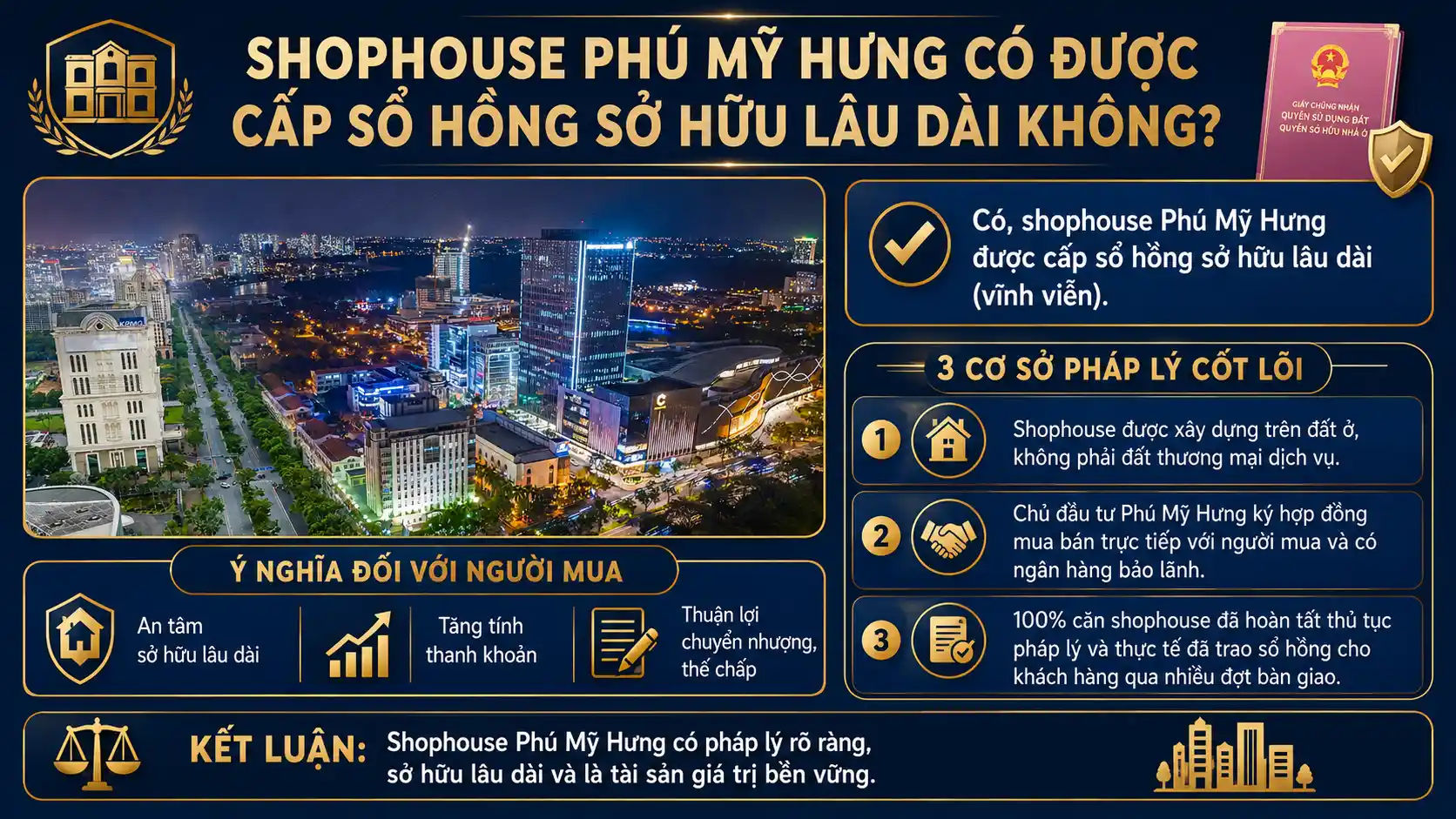
This has been demonstrated through numerous certificate-of-ownership presentation ceremonies that Phú Mỹ Hưng has held for customers buying shophouses and apartments in the various precincts of the urban area. Below are the two most important points investors need to understand clearly.
Which Types of Shophouse in Phú Mỹ Hưng Are Granted Pink Books?
There are six main groups of shophouses in Phú Mỹ Hưng that have been granted long-term ownership pink books, categorised by project and street-front location.
The table below summarises the Phú Mỹ Hưng shophouse projects that have pink books, helping investors quickly cross-reference by location and area:
| Project | Street-front location | Area | Notes |
| Grand View | Nguyen Duc Canh | 68 – 220 m² | 11 units, ground floor plus one upper floor, with basement |
| Hưng Phúc Premier | Nguyen Luong Bang | 80 – 200 m² | Ground floor plus one upper floor, long-term pink book |
| The Panorama | Within Phú Mỹ Hưng | 100 – 550 m² | Basement + floors 1 and 2 + garden |
| Scenic Valley 2 | Inside Scenic Valley precinct | 80 – 180 m² | 8 units, ground floor plus one upper floor, with garden |
| Riverside Residence | Canal-side | 80 – 200 m² | Complete legal status, long-term pink book |
| The Horizon | Tran Van Tra (Crescent Lake) | 120 – 300 m² | 3 units, prime central location |
The common feature of all the projects listed above is that the shophouses are built on the ground and first floors of commercial residential buildings, rather than being purely commercial podium blocks of condominium developments. They therefore qualify for perpetual pink books under Vietnamese housing law.
What Are the Conditions for a Phú Mỹ Hưng Shophouse to Qualify for a Long-Term Ownership Pink Book?
There are three core conditions for a Phú Mỹ Hưng shophouse to be granted a long-term ownership pink book: the land type must be residential land, the sale and purchase contract must be signed directly with the developer, and all financial obligations (taxes and fees) must be fully discharged.
Condition 1: The land type must be residential land
This is the decisive condition. Under the 2014 Housing Law (and subsequent amendments), where commercial housing is built on residential land, individual Vietnamese owners are granted certificates with no time limit. Conversely, constructions built on commercial and services land may only be owned for the duration of the land lease contract, typically 50 years. Phú Mỹ Hưng shophouses sit on residential land that has been zoned and allocated to the developer, and therefore satisfy this condition.
Condition 2: The sale and purchase contract is signed directly with the developer
Buyers need to sign an official sale and purchase contract with Phu My Hung Development Corporation (the developer), rather than through a capital contribution or investment cooperation contract. The sale and purchase contract is the legal basis for carrying out the certificate application procedures later on.
Condition 3: Full completion of financial obligations
Before submitting the pink book application file, buyers need to settle all applicable taxes and fees, including the registration fee, personal income tax (if arising from a resale), and the file appraisal fee. Phú Mỹ Hưng is committed to supporting customers throughout the entire process of completing the file submitted to the competent authority at the time the shop is handed over.
What Steps Does the Procedure for Obtaining a Phú Mỹ Hưng Shophouse Pink Book Involve?
The procedure for obtaining a Phú Mỹ Hưng shophouse pink book comprises four main steps: preparing personal and legal documents, completing financial obligations, coordinating with the developer to submit the file to the Land Registration Office, and receiving the pink book within 12 to 18 months of taking possession of the property.
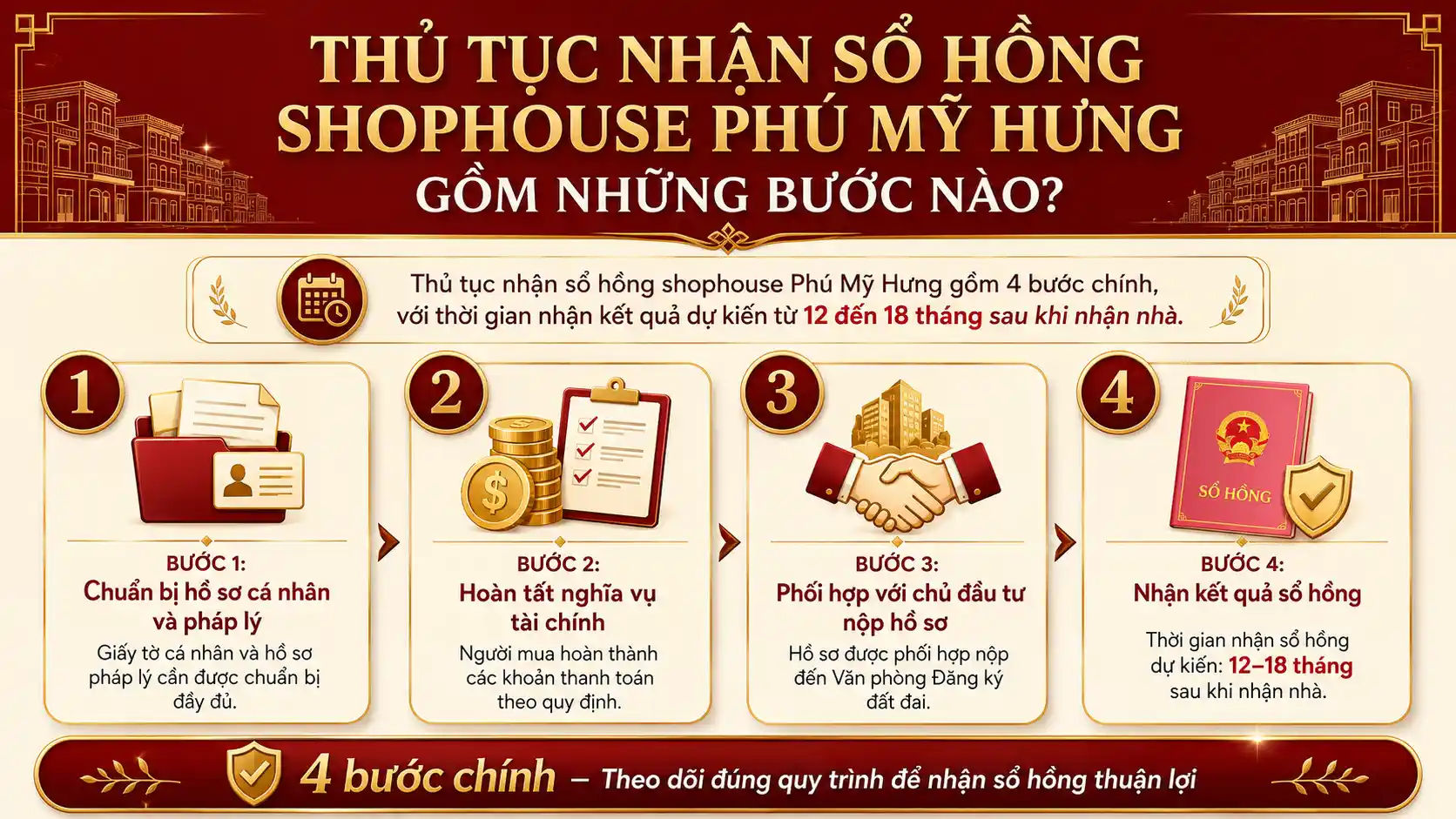
Below is a detailed breakdown of each step to help investors prepare proactively and avoid unnecessary waiting time.
What Does the Application File for a Certificate of Ownership of a Phú Mỹ Hưng Shophouse Include?
The pink book application file for a Phú Mỹ Hưng shophouse comprises five main groups of documents, which need to be prepared in full before coordinating with the developer to submit them to the competent authority.
The table below lists the groups of documents to prepare, along with important notes for each type:
| Document group | Specific documents | Notes |
| Personal identification documents | Citizen ID card/ID card (notarised copy), household registration book (if required) | Must remain valid at the time of submission |
| Sale and purchase agreement | Original sale and purchase contract signed with developer Phú Mỹ Hưng | Must be a notarised/certified version |
| Handover record | Shop handover record, acceptance record | Accompanied by photographs of the current condition |
| Financial evidence | Shophouse payment invoices, evidence of registration fee payment | Keep all original receipts |
| Application form | Application for a certificate using the Ministry of Natural Resources and Environment template | The developer assists with completing the form and checking the file |
Phú Mỹ Hưng’s supporting role at this stage is highly significant. The developer is committed to accompanying customers throughout the entire process of completing the application file for the certificate of land use rights and house ownership, then submitting it to the competent authority at the District 7 Land Registration Office (now under the management of Thủ Đức City or an equivalent administrative unit following administrative restructuring). This helps buyers avoid complex administrative procedures and shortens file processing times.
How Long Does It Take to Receive a Phú Mỹ Hưng Shophouse Pink Book?
The timeframe for receiving a Phú Mỹ Hưng shophouse pink book is typically 12 to 18 months from the date both parties sign the sale and purchase contract, depending on the progress of the project’s legal documentation and the status of the buyer’s financial obligations.
For a clearer understanding, below is a timeline broken down by each stage of the pink book issuance process:
Stage 1: Signing the sale and purchase contract and making payments (Month 1 to Month 3) After signing the sale and purchase contract with the developer and completing all payment instalments according to the agreed schedule, the buyer must keep the originals of all receipts and invoices as the basis for the pink book application dossier.
Stage 2: Handover of the shop and physical inspection (Month 3 to Month 6) Once the project is completed and meets the conditions for handover, the developer organises the handover of the shop to each customer. The handover certificate is a mandatory document in the pink book application dossier.
Stage 3: Submitting the dossier and appraisal (Month 6 to Month 12) The developer works with the customer to complete the dossier and submit it to the Land Registration Office. The competent authority appraises the dossier, carries out a site inspection and processes the financial obligations (registration fee).
Stage 4: Receiving the pink book (Month 12 to Month 18) After the dossier is approved and the financial obligations are fulfilled, the Land Registration Office issues the certificate of ownership and hands it to the owner through the developer or directly.
Factors that can lengthen the process include: delays in completing tax and fee obligations, files with missing or incorrect information, or the competent authority needing more time to process at a time when many files are being submitted. Investors should proactively work with Phú Mỹ Hưng’s legal department from the handover stage onwards to keep this time to a minimum.
What Legal Advantages Does the Phú Mỹ Hưng Shophouse Pink Certificate Offer Investors?
The pink certificate for a Phú Mỹ Hưng shophouse offers investors 3 strategic legal advantages: the ability to mortgage the property for a bank loan with a high credit limit, good liquidity when reselling, and asset value that rises sustainably over time thanks to a permanent legal foundation.
Moreover, as Vietnam’s real estate market tightens its legal requirements, owning an asset with a clear certificate has become an important screening factor that distinguishes a safe investment channel from a risky one.
Does a Permanent-Ownership Pink Certificate Make It Easier to Mortgage the Property for a Bank Loan?
Yes, the permanent-ownership pink certificate for a Phú Mỹ Hưng shophouse makes it considerably easier to mortgage the property for a bank loan because: banks accept permanent assets as collateral with loan limits of up to 50% of the shophouse’s value, offer more preferential interest rates than for time-limited ownership assets, and carry out faster assessment procedures thanks to a complete and transparent legal file.
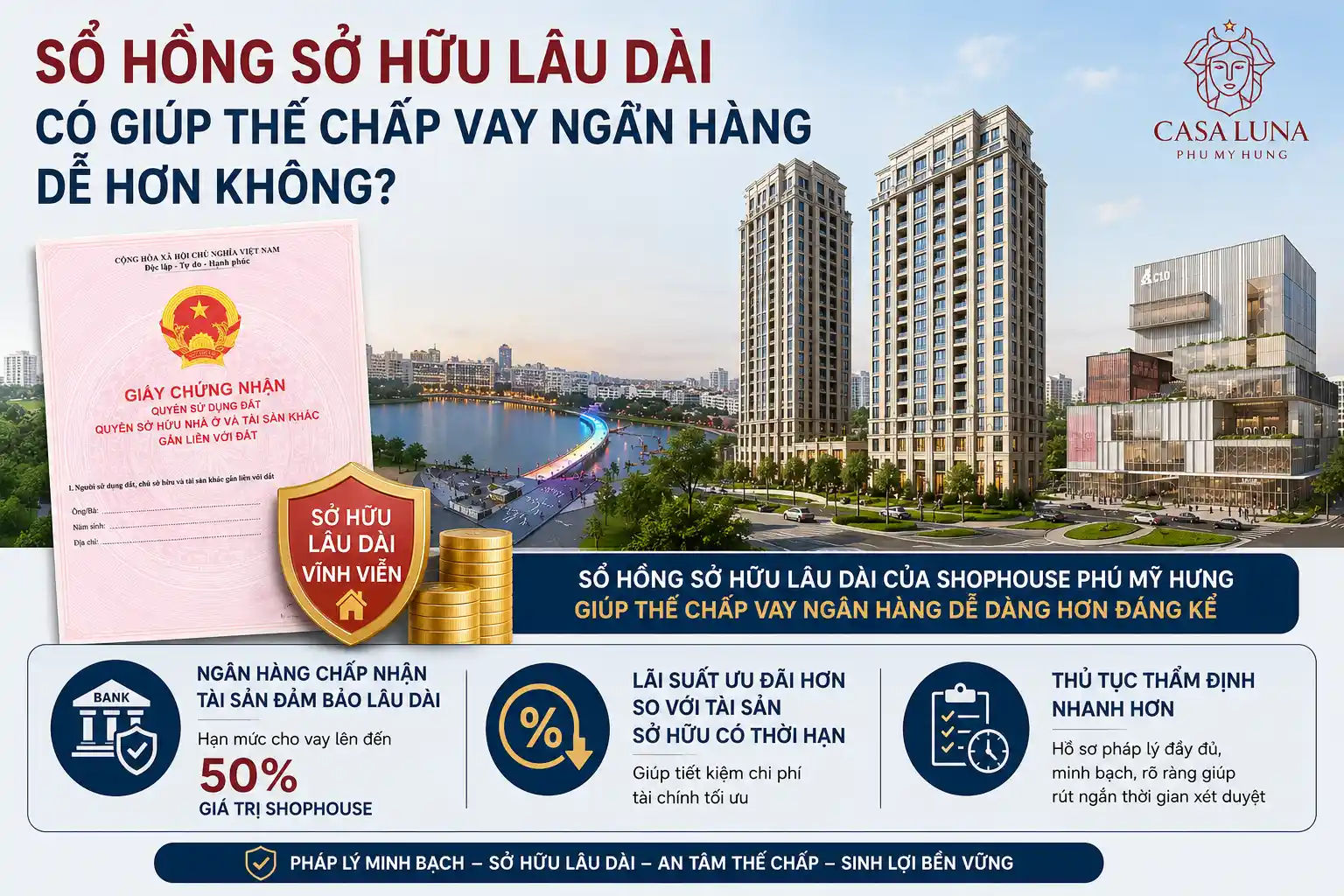
Specifically, for a Phú Mỹ Hưng shophouse with a permanent pink certificate, the bank will value the collateral at its actual market value without any deduction for ownership-term risk. By contrast, for a shophouse with only a 50-year pink certificate, especially one that has been in use for many years, the bank will apply a discount coefficient to the collateral, resulting in a lower loan limit and stricter lending conditions.
Another important advantage is that banks that have already guaranteed the Phú Mỹ Hưng project (under the mandatory bank guarantee mechanism for commercial housing) usually have disbursement procedures and internal mortgage processes optimised for this developer’s products, which shortens the approval time for investors.
Do Shophouses with a Permanent Pink Certificate Have Better Liquidity When Resold?
Yes, Phú Mỹ Hưng shophouses with a permanent pink certificate have far superior liquidity on resale compared with shophouses under time-limited ownership, because: the new buyer can still be issued a permanent pink certificate (without the remaining term being shortened as with a 50-year shophouse), the transfer procedures are simple and transparent, and this is an asset that banks are ready to finance for the new buyer.
As for the transfer procedures when reselling a Phú Mỹ Hưng shophouse with a pink certificate, the process consists of 3 main steps:
Step 1: Notarising the transfer contract Both parties (seller and buyer) take the original pink certificate, their citizen identity cards and the transfer contract to the notary office to have the contract notarised. Processing usually takes 1 to 3 working days.
Step 2: Submitting the registration of changes to the Land Registration Office After notarisation, the buyer submits the file registering the change in land use rights together with proof of payment of the registration fee. The Land Registration Office updates the new owner’s details in the system and reissues the pink certificate in the buyer’s name.
Step 3: Receiving the new pink certificate The time taken to receive the transferred pink certificate is usually 10 to 30 working days from the date the complete file is submitted, depending on the workload of the registration office at that time.
Market practice shows that Phú Mỹ Hưng shophouses with a permanent pink certificate sell faster and are less subject to price pressure than shophouses with only a written record (vi bằng) or a capital contribution contract, because the new buyer is fully protected legally and can more easily access bank financing.
How Does the Permanent-Ownership Pink Certificate for a Phú Mỹ Hưng Shophouse Differ from 50-Year Shophouses on the Market?
The pink certificate for a Phú Mỹ Hưng shophouse is superior to that of a 50-year shophouse in terms of legal status (permanent vs. time-limited), access to bank financing (higher credit limit), and liquidity value on resale (no deduction based on the remaining term of ownership).
However, investors need to be clearly aware of an important reality: on the market today there are many cases where brokers advertise shophouses as “permanent ownership” when in fact the product is built on commercial and service land and is only eligible for a 50-year certificate. This is a legal boundary that investors cannot overlook when verifying.
Why Are Most Shophouses on the Market Only Owned for 50 Years Rather Than Permanently?
Most shophouses on the market are limited to 50 years because they are built on commercial and service land (not residential land), so the ownership term is bound by the developer’s land lease contract with the State. When the land lease term expires, ownership of the assets attached to the land also ends or must be extended under the conditions set by the managing authority.
According to analysis by land law experts, shophouses in the podium of purely commercial apartment buildings (that is, apartment buildings built on residential land but with the ground floor designed for business) can fall into a legal grey area, where the commercial portion is advertised by some developers as “permanent ownership” even though the law does not actually permit this. Mr Nguyễn Văn Đỉnh, a researcher in Land Law, has pointed out that in many cases shophouses in apartment podiums do not meet the legal conditions for a permanent ownership term, even when brokers advertise them as such.
What Should Investors Check to Verify That a Shophouse Pink Certificate Really Is Permanent Ownership?
Investors need to check 4 independent legal factors to verify whether a shophouse pink certificate really is permanent ownership: the land type on the project’s red book, the land use purpose in the planning, the content of the sale and purchase contract, and the actual status of pink certificates already issued to previous customers.
Independent legal verification checklist for investors:
- Check the land type: Ask the developer or the real estate sales centre to provide the project’s Land Allocation Decision or Land Lease Contract to confirm whether the land is “residential land” or “commercial and service land.”
- Check a sample pink certificate: Ask to see pink certificates already issued to customers who bought earlier, paying particular attention to the “Land use term” section on the certificate.
- Confirm at the Land Registration Office: Look up the information on the land plot by plot number and map sheet at the District 7 Land Registration Office to verify the land type and legal status.
- Independent legal advice: Before signing a deposit agreement or sale and purchase contract, investors should hire an independent real estate lawyer (not connected to the developer or the sales centre) to review the project’s entire legal file.
For Phú Mỹ Hưng shophouses in particular, the signs that a permanent pink certificate is genuine are: the “Land use term” section on the certificate states “Permanent” (rather than a specific year such as “2073” or “50 years from…”), and the developer is willing to show the original pink certificates already issued to customers in the same project.