Triton Crown Phú Mỹ Hưng has been granted a construction permit and officially broke ground in May 2026, confirming that this is a fully lawful luxury apartment property with complete legal documentation in accordance with the current Construction Law. In particular, the commencement with main contractor Vicons and foundation piling contractor Bachy Soletanche Vietnam is the most concrete evidence of the clean legal status of the property at the time of deployment. More importantly, with the developer Phu My Hung Development Corporation having more than 33 years of experience with no recorded legal disputes, buyers have a solid basis for confidence in the comprehensive security of this property’s legal dossier.
The complete legal dossier for Triton Crown goes beyond the construction permit to include the investment policy approval decision, the land allocation decision for Lot CR9, the business registration certificate of Phu My Hung Development Corporation and the approved model sale and purchase contract, forming a closed legal chain from planning to ownership. In addition, understanding the difference between a construction permit and a pink book helps buyers grasp the full legal process from contract signing to receiving the apartment ownership certificate.
The legal framework for Triton Crown Phú Mỹ Hưng ensures buyers are granted a long-term pink book after handover, with a clear commitment from the developer in accordance with the Law on Real Estate Business 2014. Furthermore, all transactions are conducted directly with Phu My Hung Development Corporation, without intermediaries, ensuring absolute legal responsibility and that buyers’ interests are protected from start to finish.
Below, this article analyses the full legal status of Triton Crown, from the definition of a construction permit to practical confirmation, the complete dossier and the pink book commitment, giving buyers sufficient information to make a safe decision.
What is a construction permit and why must apartment buyers check it before signing a contract?
A construction permit is a legal document issued by the competent state authority to the developer, permitting lawful construction in accordance with the approved design dossier, pursuant to Article 89 of the Law on Construction 2014 as amended and supplemented.
To understand more clearly the importance of a construction permit (GPXD), it should be seen not merely as a simple administrative procedure but as the mandatory legal foundation for the entire life cycle of a property development.
Under Article 89 of the Law on Construction 2014 as amended, all apartment residential buildings of 9 storeys or more must have a GPXD before commencement. If a developer carries out construction without a permit, the works are deemed unauthorised and may be subject to enforced suspension, administrative fines or forced demolition under Decree 16/2022/ND-CP.
More importantly, the causal link between the construction permit and the pink book is something apartment buyers need to fully understand. The legal chain operates in sequence: a valid construction permit allows construction in accordance with the registered design, the building is then successfully inspected and accepted, and only on that basis does the developer have sufficient grounds to submit the application for the state authority to issue pink books to buyers. If any link in this chain breaks, all of the buyer’s legal interests are seriously affected.
Furthermore, apartment buyers need to check the construction permit before paying a deposit for three practical reasons. The first reason is that the construction permit confirms the project has passed all technical appraisal stages, including architectural design, structural design, fire prevention and firefighting, and urban planning. The second reason is that the construction permit proves the developer’s land use rights for the construction site are valid. The third reason is that the construction permit is the sole legal basis for the state authority to later confirm the building was constructed as registered and to proceed with issuing a pink book for each apartment.
According to statistics from the Ministry of Construction, more than 90% of cases where apartments are delayed in being granted pink books or are never granted them stem from the developer not holding a valid construction permit or building differently from the approved design.
Has Triton Crown Phú Mỹ Hưng been granted a construction permit?
Yes, Triton Crown Phú Mỹ Hưng has been granted a valid construction permit, confirmed by three factual grounds: the project officially commenced construction in May 2026, main contractor Vicons and piling contractor Bachy Soletanche Vietnam have been carrying out construction works, and all information has been officially published by Phú Mỹ Hưng on the developer’s media channels.
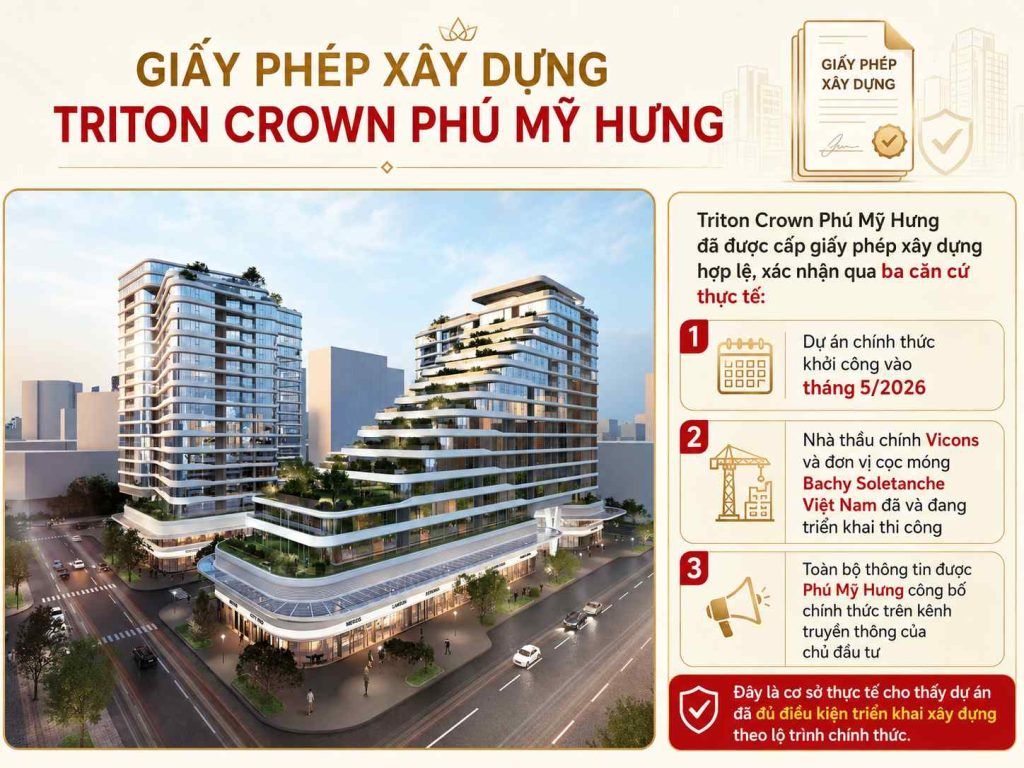
More specifically, under the Law on Construction, the official commencement of a building is a binding legal act that may only take place after all preconditions have been fulfilled, including the construction permit having been granted, the construction design having been approved and the occupational safety dossier having been submitted to the competent authority. Let us explore each actual construction stage in detail and the authority competent to grant the construction permit for this project.
What is the actual construction status of Triton Crown as of May 2026?
The construction status of Triton Crown as of May 2026 is at stage 2, meaning all piling and diaphragm wall works have been completed, and above-ground structural works have officially commenced according to the official announcement from Phú Mỹ Hưng.
Specifically, the construction progress of Triton Crown has proceeded in two clear stages as follows.
Stage 1 is the construction of piles and diaphragm walls, carried out by Bachy Soletanche Vietnam, one of the leading foundation contractors in Vietnam with an extensive portfolio of international projects. The appointment of a specialist contractor for the foundations of the 18-storey building shows that Phú Mỹ Hưng strictly complies with the construction process in line with the technical standards approved in the construction permit.
Stage 2 is the official commencement of the superstructure in May 2026, with Vien Dong Construction and Engineering Services Co., Ltd. (Vicons) acting as the main contractor. In addition, Saigon Construction Inspection Joint Stock Company 2 acts as the independent supervision consultant, ensuring the building is constructed in accordance with the design dossier and the approved construction permit throughout the construction process.
Regarding the overall programme, the implementation schedule for the Triton Crown project as announced by Phú Mỹ Hưng follows three key milestones: commencement of construction in Q4 2025 (piling and diaphragm wall stage), official launch for sale expected in Q4 2026, and handover of completed apartments to buyers in Q4 2028. According to the actual update in May 2026, the project is carrying out piling and basement construction, keeping closely to the schedule committed to buyers.
Which authority is competent to grant the construction permit for the Triton Crown project in District 7, HCMC?
The HCMC Department of Construction is the sole authority competent to grant the construction permit for the Triton Crown project, as this is a residential apartment building of 9 storeys or more, falling within the Department of Construction’s delegated authority under Article 103 of the Law on Construction 2014 as amended.
Specifically, the construction permit application dossier that Phú Mỹ Hưng must submit to the HCMC Department of Construction includes the mandatory documents as prescribed:
- Technical design and construction drawings appraised by an independent appraisal organisation
- Decision approving the detailed 1/500 construction planning for the CR9 site
- Land allocation decision or valid land use rights of Phú Mỹ Hưng granted by the HCMC People’s Committee
- Fire prevention and firefighting approval results from the Fire Police Department
- Structural safety assessment dossier for buildings of 18 storeys or more, carried out by an independent appraisal organisation
More importantly, under current legislation, the construction permit must be issued and the developer must fulfil its land-related financial obligations to the state before signing a sale contract with any customer. This means that when buyers sign the Triton Crown sale contract in Q4/2026, the construction permit will be fully valid and all related financial obligations will have been fully discharged in accordance with regulations.
What documents are included in the complete legal dossier of the Triton Crown Phú Mỹ Hưng project?
The complete legal dossier for Triton Crown Phú Mỹ Hưng comprises 5 core groups of documents, covering the process from planning to ownership: the decision approving the investment policy, the land allocation decision for Lot CR9, the construction permit, the developer’s business registration certificate and the approved standard sale contract.
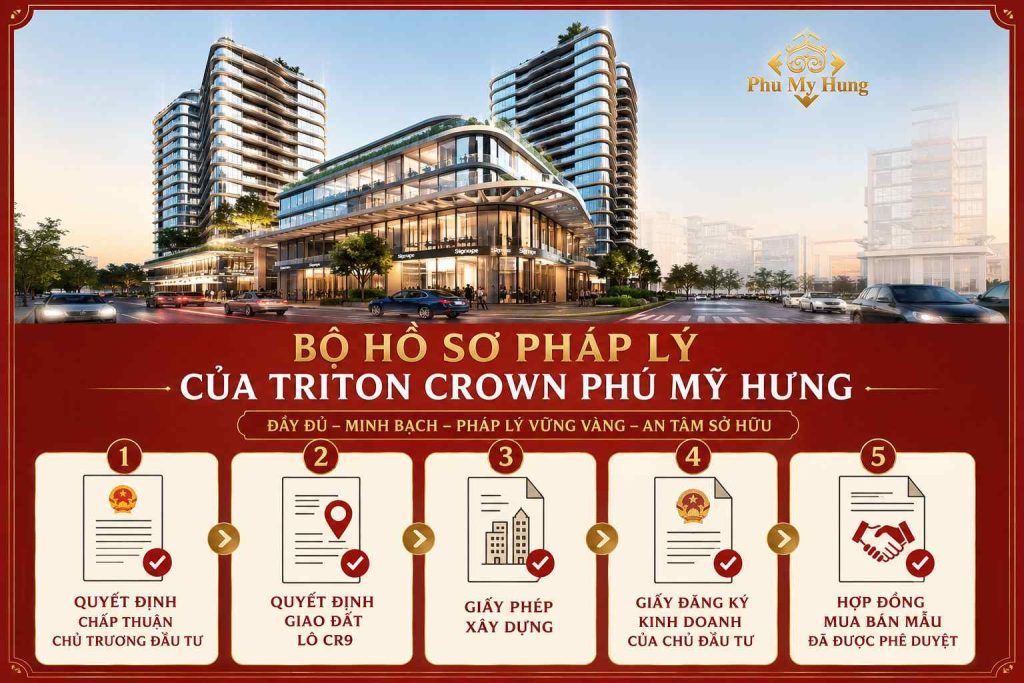
Below is a detailed analysis of each group of documents and its specific role in the legal framework protecting apartment buyers’ rights.
What types of legal documents should buyers request to see before signing the Triton Crown sale contract?
Buyers should request to see and verify 5 types of legal documents before signing the Triton Crown sale contract. Each document serves a different role and cannot be substituted for another in protecting the buyer’s lawful ownership rights.
The table below summarises the 5 core groups of legal documents for the Triton Crown project, the legal function of each type and the competent state authority that issues it, helping buyers know precisely which documents to request and which authority to consult for verification:
| Document type | Legal function | Issuing authority |
| Decision approving the investment policy | Confirms that the project’s investment objectives and scale have been approved by the State | UBND TP.HCM |
| Decision on land allocation / land-use rights for Lot CR9 | Confirms that Phú Mỹ Hưng has lawful land-use rights at the construction site | UBND TP.HCM |
| Construction permit | Permits construction in accordance with the appraised and approved design | Ho Chi Minh City Department of Construction |
| Phú Mỹ Hưng’s business registration certificate | Confirms the developer’s legal status, business lines and financial capacity | Ho Chi Minh City Department of Planning and Investment |
| Approved standard sale contract | Confirmation that the transaction terms comply with the 2014 Law on Real Estate Business | Ho Chi Minh City Department of Construction |
In addition, the appropriate approach is to require the developer to provide notarised copies of, or allow access to the originals of, each of the documents listed above before paying any deposit. Buyers have the right to refuse or suspend the transaction if the developer fails to provide all these documents when requested.
In particular, with Triton Crown, customers sign the sale and purchase contract directly with Phu My Hung Development Corporation, without going through any intermediary real estate sales centre. This completely eliminates the risk of an invalid authorisation contract or disputes over the seller’s legal status, ensuring that legal responsibility clearly rests with the correct legal entity, namely the developer.
How does a construction permit differ from a pink book, and how are these two documents related?
A construction permit serves as the developer’s input, while a pink book serves as the buyer’s output, and the two documents are linked through an irreversible linear chain of causation in the property legal process.
To illustrate the differences and relationship, they can be analysed across three specific dimensions of comparison.
In terms of the recipient: a construction permit is issued to the developer to carry out construction lawfully, while a pink book is issued to the apartment buyer to confirm lawful ownership and the land-use rights attached to that apartment.
In terms of the time of issue: a construction permit is issued before construction begins, whereas a pink book is issued only after the entire project has been completed, inspected and accepted, and handed over by the developer to the buyer.
Regarding the legal chain of causation, the process is linked vertically as follows: a valid construction permit allows construction in accordance with the registered design; once construction has been completed in accordance with the construction permit, the developer carries out acceptance procedures; the relevant authority confirms that the project meets technical and safety standards; the developer submits the application for pink books to the Department of Natural Resources and Environment; within 30 days of receiving a valid application, the competent authority completes the issuance of a pink book for each apartment.
However, if the developer constructs the project inconsistently with the issued construction permit, the entire chain is interrupted: the acceptance application is rejected, the state authority does not issue pink books, and the developer is required to demolish the non-compliant construction or revise the design. For Triton Crown, this risk is tightly controlled by the independent supervision consultant, Saigon 2 Construction Inspection Joint Stock Company, whose responsibility is to confirm at each stage that the entire project is constructed in accordance with the approved design documentation.
Does Triton Crown’s legal status ensure that buyers will receive long-term pink books after handover?
Yes, Triton Crown Phú Mỹ Hưng’s legal status ensures that buyers will receive long-term pink books through three specific and verifiable commitments: the developer’s commitment under the contract terms, the mandatory legal obligation under Article 13 of the 2014 Law on Real Estate Business, and Phú Mỹ Hưng’s practical record of issuing pink books on time across more than 110 projects implemented.

Specifically, under Clause 4, Article 13 of the 2014 Law on Real Estate Business, the developer is legally obliged to carry out the procedures for the state authority to issue the Certificate of Land Use Rights, Ownership of Houses and Other Assets Attached to Land to the buyer within 50 days of the date of house handover. This is not a voluntary commitment but a mandatory legal obligation, backed by penalties if the developer breaches the deadline.
In addition, the form of ownership at Triton Crown is clearly distinguished according to the buyer. Vietnamese citizens are issued pink books with an unlimited long-term ownership term, while foreign individuals or organisations are issued pink books with a 50-year ownership term from the date of issue, in accordance with the 2023 Law on Housing.
More importantly, Phú Mỹ Hưng’s 33-year track record is the strongest and indisputable evidence. All previous projects, including Cảnh Viên 1 and 2, Garden Court 1 and 2, Scenic Valley, Happy Valley, Garden Plaza, Riverside Residence, The Regency and The Sculptura, have had pink books issued to buyers on time or earlier than committed. No case has arisen involving a legal dispute concerning the refusal or delay of pink-book issuance at any of this developer’s projects.
In particular, with Triton Crown, buyers sign the sale and purchase contract directly with Phu My Hung Development Corporation, without going through any intermediary distribution centre. This direct transaction model ensures that all terms concerning the handover schedule, the commitment to issue pink books and buyers’ rights are clearly recorded in the official contract signed with the correct legal entity, namely the developer, completely eliminating risks arising from a third-party distributor.
What legal risks arise if an apartment project does not have a valid construction permit or is built inconsistently with the issued permit?
A project without a valid construction permit or built in breach of its permit faces 4 serious legal consequences: compulsory suspension of construction, an administrative fine of between 40 and 100 million VND depending on the severity of the breach, refusal to issue pink books to buyers, and compulsory demolition of the non-compliant construction under Article 15 of Decree 16/2022/NĐ-CP.
In addition, this is precisely the opposite of Triton Crown in the legal landscape of property in Ho Chi Minh City. Triton Crown has obtained a valid construction permit, commenced construction in accordance with legal procedures and is supervised by an independent inspection organisation. Meanwhile, many other projects on the market are still being sold in the form of “reservation documents” or “capital contribution contracts” before meeting the full legal conditions required by regulations, exposing buyers to uncontrollable risks.
How can apartment buyers independently check whether a project’s construction permit is valid?
Buyers can independently check the validity of a construction permit in 3 practical ways: access the Ho Chi Minh City Department of Construction’s electronic information portal to look up project information, request a notarised copy of the construction permit from the developer before signing a deposit agreement, and cross-check the construction permit number against the site signboard, which must be displayed in accordance with regulations. In addition, buyers should recognise 3 warning signs of a project with non-transparent legal documentation: the developer refuses to provide the construction permit, there is only a “reservation document” instead of an official sale and purchase contract, and there is no land allocation decision in the developer’s name. The minimum 5-point checklist before transferring a deposit includes: confirming the construction permit number and issuing authority; checking the land allocation decision; reviewing the draft sale and purchase contract; looking up the developer’s business registration certificate; and requesting documents proving that land-use fees have been paid.
Why is Phú Mỹ Hưng’s legal position considered safer than that of most other developers in the Ho Chi Minh City market?
Phú Mỹ Hưng’s legal position is considered safer thanks to 3 distinctive factors that no developer in Ho Chi Minh City can replicate. First, Phú Mỹ Hưng is the only developer officially recognised by the Ministry of Construction as a model urban area in 2008, signifying consistent legal standards from the master plan through to each individual residential property. Second, more than 33 years of development and over 110 projects have recorded no cases of a construction permit being revoked, construction being suspended for violations or buyers not being issued their ownership certificates—a track record that cannot be disputed. Third, the model of signing contracts directly with the developer under the 2023 Housing Law completely eliminates legal risks arising from intermediary real estate sales centres, ensuring that full legal responsibility rests with the legal entity Phu My Hung Development Corporation throughout the project’s life cycle.