The developer of Triton Crown is Phu My Hung Development Corporation, a legal entity established in 1993 as a joint venture between IPC (Industrial Investment and Development Corporation — the Vietnamese side) and CT&D (Taiwan). Customers buying Triton Crown sign the sale and purchase contract directly with Phu My Hung Development Corporation, without any intermediary distributor, ensuring that all legal rights are fully protected from the date of deposit to the date the pink book is received.
On the developer’s reputation, the answer is Yes, with 3 irrefutable pieces of evidence: 33 years of continuous operation with no precedent of major legal disputes, 110+ projects completed and handed over on schedule, and the title of Vietnam’s only ‘model urban area’, officially recognised by the Ministry of Construction in 2008. In addition, four leading banks — Vietcombank, BIDV, VietinBank and Standard Chartered — guarantee Triton Crown’s progress, adding a layer of financial protection independent of the developer’s goodwill.
As for the list of notable completed projects, Phú Mỹ Hưng has successfully delivered a series of luxury apartment projects including The Sculptura, The Regency, Casa Luna, Midtown (M5-M8), The Horizon, The Antonia and The Ascentia — all handed over on time and with sustainable value growth of 15-20% per year in projects by Crescent Lake.
Below is a detailed analysis, from the legal entity’s identity and specific evidence of reputation to the list of notable projects, giving buyers of Triton Crown enough information to make an informed decision.
Who is the developer of Triton Crown and how was it established?
The developer of Triton Crown is Phu My Hung Development Corporation, established in 1993 as a joint venture between IPC (the Vietnamese party) and CT&D (Taiwan). After 33 years, it has developed a 2,630-ha model urban area with more than 60,000 residents from over 30 countries in the southern area of Ho Chi Minh City.
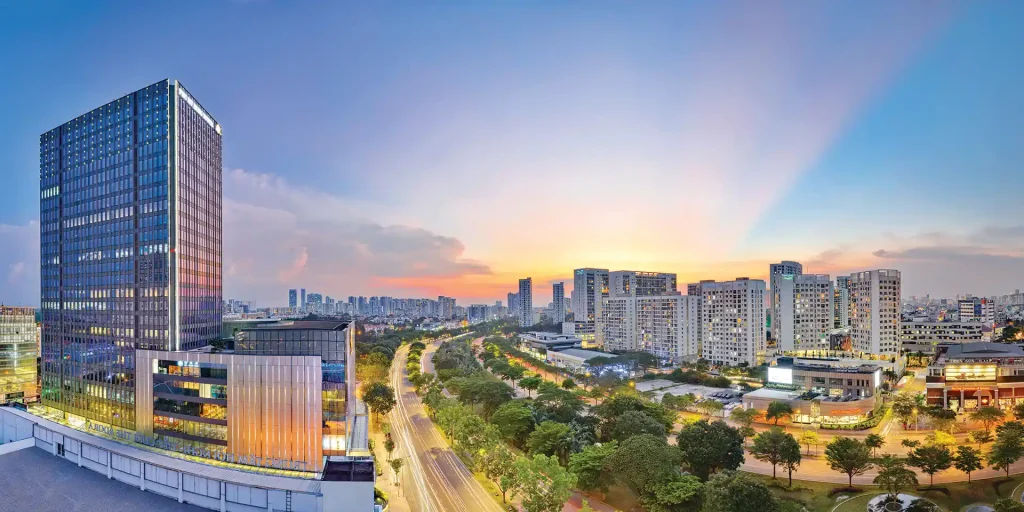
To understand more clearly why information about the developer’s legal entity is important to Triton Crown buyers, it is worth remembering that the legal entity named in the sale contract directly determines who bears legal responsibility for progress, quality and the pink book. At Triton Crown, buyers sign the contract directly with Phu My Hung Development Corporation, not with an agent or intermediary real estate sales centre. This means that all commitments in the contract, from the handover date to the deadline for issuing the pink book, are Phu My Hung’s direct legal obligations. Let’s explore the ownership structure and actual scale of this legal entity in detail.
Which parties form Phu My Hung Development Corporation as a joint venture, and what is each party’s role?
Phu My Hung Development Corporation is a joint venture between 2 parties: IPC (the Industrial Investment and Development Corporation — representing the Vietnamese side) and CT&D Group (Taiwan — representing foreign capital and international urban management expertise), with each contributing different strategic resources to create a unique combined strength in Vietnam’s real estate market.
Specifically, regarding the role of each party, IPC provides lawful access to land, an understanding of the Vietnamese market and relationships with state management authorities in Ho Chi Minh City. This is a key factor enabling Phu My Hung to complete the legal procedures for each plot of land and each project with a speed and ease that a purely foreign developer could not achieve. In addition, CT&D Group brings foreign investment capital, experience in developing large-scale urban areas in Asia and a partnership with SOM (Skidmore, Owings and Merrill) — a leading US urban planning firm that designed the entire master plan for Phú Mỹ Hưng to American urban standards.
The result of this joint venture is a distinctive urban development model: “local understanding + international standards”. Phú Mỹ Hưng has planned, built and operated the entire urban infrastructure, from roads, greenery and drainage to electricity and internet systems, from the outset across 2,630 ha of previously uncultivated agricultural land. This is something that most Vietnamese real estate developers have been unable to do because they only develop individual projects on land with basic infrastructure already in place. More importantly, the IPC x CT&D joint venture structure creates a system of balanced control: CT&D’s commercial interests are balanced by IPC’s social responsibility, ensuring that Phú Mỹ Hưng not only maximises profit but also maintains sustainable urban quality.
What are the overall scale and achievements of Phu My Hung Development Corporation after 33 years?
After 33 years, Phu My Hung Development Corporation has a scale comprising 110+ completed projects, 20,000+ homes handed over and 60,000+ residents living in the 2,630-ha urban area, of whom 30% are foreigners from over 30 countries.
The table below summarises Phú Mỹ Hưng’s key scale figures as of 2026, helping Triton Crown buyers understand the developer’s size and depth of experience before signing the contract:
| Indicator | Figure | Significance |
| Years of operation | 33 years (since 1993) | One of the longest-established developers in Vietnam |
| Total urban area | 2.630 ha | Larger than the entire Hoan Kiem District, Hanoi |
| Completed projects | 110+ projects | An average of more than 3 projects per year |
| Residential units handed over | 20.000+ units | All on schedule, with no backlog of pink books |
| Current residents | 60.000+ people | A truly multinational township |
| Proportion of foreign residents | 30% | From 30+ countries — proven international standard |
On titles and awards, Phú Mỹ Hưng has received numerous official national and international recognitions that no Vietnamese real estate developer at the same time has achieved. In particular, in 2008 the Vietnamese Ministry of Construction officially recognised Phú Mỹ Hưng as a “Model Township” — the only title in the history of Vietnam’s real estate sector awarded to a private township. Previously, Phú Mỹ Hưng received the American Urban Architecture Award in 1995 and 1997 — an international achievement that no Asian developer could easily attain. In 2007, the Vietnamese State awarded the Labour Order, First Class — the highest evidence of PMH’s contribution to the nation.
Is the Triton Crown developer — Phú Mỹ Hưng reputable?
Yes, the Triton Crown developer — Phú Mỹ Hưng has a leading reputation in Vietnam’s real estate market for 3 undeniable core reasons: 33 consecutive years without a single precedent of major legal dispute, 110+ projects handed over on or ahead of the committed schedule, and all 20.000+ residential properties granted individual long-term pink books in accordance with regulations.

On the reputation of the Triton Crown developer, the most important thing to understand clearly is that PMH’s reputation is not a boast but a chain of practical results that can be verified through each specific project. Anyone can find out for themselves by contacting residents of Midtown, The Horizon or The Antonia to confirm the reality: were homes handed over on time? How long did the pink books take to be issued? Does the quality differ from the original design? The consensus answer from actual residents is a stronger guarantee of reputation than any marketing document. Let us explore in detail the two most important aspects of reputation: the actual delivery schedule history and the system of titles verified by third parties.
Has Phú Mỹ Hưng’s delivery schedule across projects before Triton Crown really been on time?
Yes, Phú Mỹ Hưng’s delivery schedule history has indeed been on time throughout all 33 years of operation due to 3 simultaneous safeguard mechanisms: direct contractual commitments with the developer without intermediaries, a strict internal construction control system, and schedule guarantees from 4 leading banks on every modern project.
Specifically, PMH’s most recent luxury apartment projects have all been handed over on the schedule committed in the contracts. Midtown (including M5 The Grand, M6 The Symphony, M7 The Signature and M8 The Peak) is PMH’s largest collection of 4 luxury apartment projects before Triton Crown; all were handed over on time, with pink books issued within 3-6 months of handover. The Horizon and The Ascentia, the two apartment projects beside Bán Nguyệt Lake from the generation before Triton Crown, were also handed over on schedule and their pink books issued in accordance with regulations. Notably, no project in Phú Mỹ Hưng’s 33-year history has been subject to resident complaints about delayed handover or a backlog of pink books caused by the developer.
At Triton Crown, in addition to the schedule commitment in the contract, buyers are also protected by 4 guaranteeing banks, namely Vietcombank, BIDV, VietinBank and Standard Chartered. Under the Law on Real Estate Business 2023, if the developer hands over later than committed in the contract, buyers have the right to request the guaranteeing bank to pay full compensation for damages. This is a legal protection mechanism independent of the developer’s good faith, applied automatically when the conditions are triggered. The reality is that Phú Mỹ Hưng has never required a guaranteeing bank to intervene and pay compensation for schedule reasons — that is the highest evidence of reputation.
Which prestigious awards and titles has Phú Mỹ Hưng received to date?
Phú Mỹ Hưng has received 5 groups of prestigious awards and titles according to recognition-source criteria (the Vietnamese State, international organisations, the real estate sector): Model Township (Ministry of Construction, 2008), the American Urban Architecture Award (1995 and 1997), the Labour Order, First Class (the Vietnamese State, 2007), “Most Reputable Real Estate Developer” (2018) and the title “Little Singapore” from the international media.
On the significance of each accolade, the Model Urban Area title conferred by Vietnam’s Ministry of Construction in 2008 carries the most weight, because it is official recognition from a state body at ministerial level — not a commercial vote or an industry association. In the history of Vietnamese urban development, no private urban area other than Phú Mỹ Hưng has been granted this title. In addition, the American Urban Architecture Awards of 1995 and 1997 are the earliest international evidence: only 2-4 years after its founding, PMH was recognised by American architects and planners — at a time when most Vietnamese real estate developers had not yet come into being. The First-Class Labour Medal in 2007 is evidence that the Vietnamese state officially acknowledged PMH’s contribution to the economic development and urbanisation of HCMC — a credible proof that cannot be forged or bought.
According to information confirmed on the official homepage phumyhungreals.com.vn, Phú Mỹ Hưng is rated as “one of the most reputable real estate developers in Vietnam” thanks to “project quality with transparent legal status, construction progress as committed, high construction quality, no difference from the original design.”
Which notable Phú Mỹ Hưng projects were completed before Triton Crown?
Phú Mỹ Hưng has 3 groups of notable completed projects before Triton Crown, by product type: the heritage collection of high-end apartments (The Sculptura, The Regency, Casa Luna), the Midtown group (M5-M8) and the earlier generation of projects along the Crescent Lake (The Horizon, The Ascentia, The Antonia).
To understand more clearly what this list of projects means for Triton Crown buyers, it should be seen not simply as a marketing portfolio but as a chain of practical evidence: each completed project is a schedule and legal commitment that was kept, an ownership certificate that was issued and a community of residents actually living in the building. Below is a detailed analysis of the two project groups most important to those considering buying Triton Crown Phú Mỹ Hưng.
Which projects make up Phú Mỹ Hưng’s heritage collection of high-end apartments before Triton Crown?
Phú Mỹ Hưng’s heritage collection of high-end apartments before Triton Crown comprises 3 launched projects: The Sculptura, The Regency and Casa Luna, each with a completely distinct architectural language and design philosophy, serving three different aesthetic groups within the elite resident segment.
Specifically on each project in the collection:
The Sculptura is the first project of the PMH 2.0 heritage collection, carrying a bold contemporary artistic sculptural language with striking asymmetrical forms. The Sculptura serves residents who regard living space as a statement of artistic personality. The project has completed its sales launch and successfully introduced its show apartment, continuing PMH’s history of on-time handover.
The Regency is the second project, in a stately, luxurious neoclassical style with modernised classical European architecture, aimed at residents who value endurance and traditional class. The Regency is located in the central position of the Crescent Lake, right beside the lakeside promenade axis, and has also been handed over according to the schedule PMH announced from the outset. In particular, The Regency is the most important reference project when assessing Triton Crown, as it is in the same lakeside sub-area, the same high-end segment and by the same developer.
Casa Luna is a Sky Villa project along the Crescent Lake, a high-rise villa type combining Mediterranean architecture and terraced design, also within the Crescent Lake area and successfully launched. Moreover, the three projects in this heritage collection, together with Triton Crown, form four architectural “jewels” of PMH 2.0, each an original heritage architectural work with a design language that is entirely unrepeated.
Were Midtown and PMH’s earlier lakeside projects handed over on time, and did they rise in price?
Yes, the whole of Midtown (M5-M8) and PMH’s earlier Crescent Lake projects were all handed over on time and recorded price growth of 15-20% per year according to historical real estate market data for southern HCMC.
Specifically on the Midtown group, the quartet of towers M5 The Grand, M6 The Symphony, M7 The Signature and M8 The Peak form the largest-scale high-end apartment system PMH had developed up to Triton Crown, developed together with Japanese partner Nomura in the central PMH area. All 4 Midtown towers were handed over on the schedule committed in the contract, ownership certificates were issued in full, and it is now the high-end apartment area with the highest reference price in District 7. In addition, The Antonia is a low-rise townhouse project handed over on time with a separate ownership certificate for each unit.
As for the previous generation of projects along Bán Nguyệt Lake, The Horizon and The Ascentia are two apartment projects on the Bán Nguyệt Lake waterfront that were handed over before Triton Crown and are the most important direct reference point. The Horizon was handed over on schedule, the pink book certificate was issued within 3-6 months of handover, and current prices show a significant rise on launch prices — concrete evidence for the “15-20% per year” claim that PMH and agents often cite. The Ascentia, also on the lakefront and handed over on time, is now the apartment area with the highest proportion of foreign residents in the whole of PMH.
According to the information recorded: “A series of earlier projects such as Midtown, The Horizon, The Antonia and The Ascentia were all handed over on schedule, with outstanding quality and impressive added value.”
What makes Phú Mỹ Hưng different from other luxury real estate developers in Vietnam?
Phú Mỹ Hưng wins on the integrated urban model “from bare land”, single-project developers are strong on speed of delivery, and no developer in Vietnam has achieved both at once at a comparable scale.

Specifically, what makes PMH’s difference fundamental is not its price level or better design but the structure of its urban development model: PMH built and operates the entire urban infrastructure (roads, greenery, drainage, electricity, internet, security) from when the land was still bare, without depending on state infrastructure supplied from outside. Most Vietnamese real estate developers, by contrast, build only the building itself and depend entirely on external social infrastructure provided by the state or by other developers.
Why does Phú Mỹ Hưng’s “urban area from bare land” model create a different kind of guarantee compared with single-project developers?
PMH turned 2,630 ha of abandoned farmland in the southern part of Ho Chi Minh City into an international model urban area over 33 years. No Vietnamese developer has done this at a comparable scale. PMH does not merely build the building; it controls the entire environment around that building — from the asphalt of the pavements and the tree systems along the roads to the service standards of the ground-floor shophouses. A single-project developer has no control over the infrastructure surrounding its project, which creates the risk of the living environment being affected by factors beyond its control. At Triton Crown, PMH itself is the party controlling quality across the whole Crescent area — the living environment inside and outside the building is the responsibility of the same legal entity.
How does the IPC (Vietnam) and CT&D (Taiwan) joint venture at Phú Mỹ Hưng differ from ordinary FDI?
Unlike ordinary FDI, where foreign investors pour in capital to maximise short-term profit and then withdraw, CT&D committed to long-term urban development and operation alongside IPC under a “socially responsible urban area” model, which explains why PMH never maximises the number of apartments on a given plot of land but always keeps building density low. IPC represents the interests of the Vietnamese state in the joint venture, creating a planning policy control mechanism that is not entirely manipulated by commercial interests. The result is that PMH, after 33 years, embodies a sustainable urban development model combining market advantage (CT&D), social responsibility (IPC) and international standards (American-standard SOM planning) — a combination rarely found in any developer in Southeast Asia in the same period.
If you are interested in Phú Mỹ Hưng projects, please contact Phú Mỹ Hưng Center for accurate advice and the latest information. Consultant Kim Thùy has extensive experience and is always ready to help you choose a project suited to your needs for living or investment, and provides full information on price lists, unit layouts, sales policies and legal matters.
Phumyhungcenter.com is a reliable website that accompanies customers throughout the process of researching and transacting Phú Mỹ Hưng projects.