Casa Luna Phú Mỹ Hưng has a valid construction permit, as directly confirmed by the project’s official groundbreaking ceremony on 06/03/2026 at plot CN8-2 in the Kênh Đào sub-area of Phú Mỹ Hưng. Under Vietnam’s 2014 Construction Law (amended in 2020), no construction project may commence without a construction permit issued by the competent authority. Holding a large-scale groundbreaking ceremony attended by the authorities, contractor and supervising entity is irrefutable legal evidence.
The Casa Luna Phú Mỹ Hưng project legal dossier includes all 5 groups of documents required by law: the land-use rights certificate for plot CN8-2, the construction permit issued by the Ho Chi Minh City Department of Construction, the developer Phú Mỹ Hưng’s business registration certificate No. 0101871229, planning approval and design approval documents, and fire prevention and fighting certification. A three-party system comprising developer Phú Mỹ Hưng, main contractor Vicons and independent supervising entity DSPCons VN closely controls the entire construction process.
In addition, Casa Luna’s legal roadmap has been clearly announced in 3 stages: groundbreaking on 06/03/2026 with all permits in place; expected handover in July 2028, together with building acceptance and issuance of long-term ownership certificates to Vietnamese purchasers after completion of the real-estate transaction registration procedures. In particular, the final 5% payment is collected only when the buyer actually receives the ownership certificate, representing Phú Mỹ Hưng’s strongest binding legal commitment.
Below is the complete detailed analysis of Casa Luna Phú Mỹ Hưng’s construction permit, full legal dossier and committed roadmap to the ownership certificate, providing you with a complete basis for making a confident and secure investment decision.
Has Casa Luna Phú Mỹ Hưng Been Granted a Construction Permit?
Yes, Casa Luna Phú Mỹ Hưng has been granted a valid construction permit, with at least 3 pieces of practical evidence confirming this: the official groundbreaking ceremony on 06/03/2026 attended by state authorities, the specific identification of land plot CN8-2 in the published documents, and the 33-year record of on-time handovers achieved by developer Phú Mỹ Hưng.
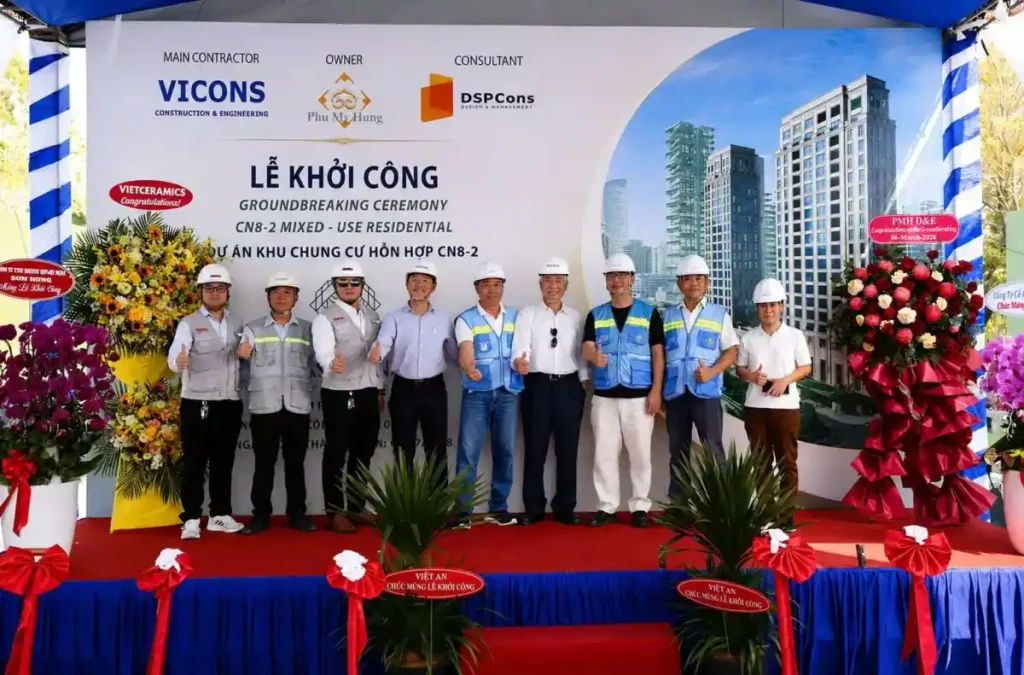
More specifically, under Article 89 of the 2014 Construction Law (amended in 2020), all buildings of 7 storeys or more must have a construction permit before work begins. Breaching this regulation may result in a construction suspension order, compulsory demolition and heavy administrative penalties. On the morning of 06/03/2026, Casa Luna’s groundbreaking ceremony was held on the appropriate scale at plot CN8-2 in the Kênh Đào sub-area, attended by leaders of Phú Mỹ Hưng, main contractor Vicons, supervising consultant DSPCons VN and local government representatives. The presence of state regulatory authorities at the groundbreaking ceremony is the strongest implied confirmation of the legal validity of the project’s entire dossier.
Furthermore, the second particularly compelling piece of evidence is Phú Mỹ Hưng’s 33-year operating history in Vietnam. Over more than 3 decades, none of Phú Mỹ Hưng’s projects has been suspended for legal violations or a lack of a construction permit. This is the most valuable type of evidence of legal capability for investors: not a written commitment, but a verifiable track record demonstrated by completed projects such as The Regency, Green Valley, Midtown and many others within the same urban area.
More importantly, during the preparation period from late 2025 to early 2026, developer Phú Mỹ Hưng publicly stated that “site preparation, legal procedures and detailed design were being carried out urgently and diligently”. This is the usual language used by a developer finalising the last stage of its legal dossier before applying for and receiving a construction permit, rather than the language of a project facing legal obstacles. The project’s subsequent on-time groundbreaking demonstrates that the legal preparation process was successfully completed.
Casa Luna project information: https://phumyhungcenter.com/du-an/casa-luna-phu-my-hung/
Which Authority Issued Casa Luna’s Construction Permit, and What Does It Confirm?
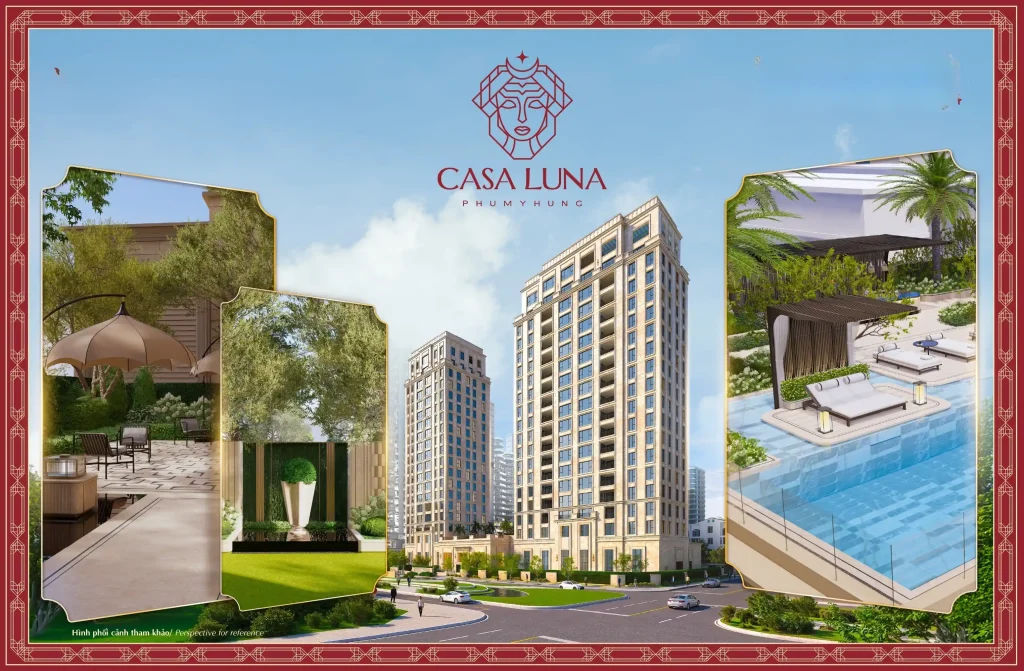
The Casa Luna building permit is a legal document issued by the Ho Chi Minh City Department of Construction to the developer, Phú Mỹ Hưng, confirming that the project has fully satisfied the conditions under the 2014 Law on Construction (as amended in 2020) regarding planning, architecture, structural safety and environmental requirements for a 20-storey high-rise residential building.
Specifically, the building permit is not the only document, but rather the end point of a mandatory sequential legal process. To obtain the building permit, the developer, Phú Mỹ Hưng, must fully complete all the preceding steps in the prescribed order. The table below shows the complete mandatory legal sequence that Casa Luna must go through before it can officially commence construction:
| Phase | Legal document | Issuing authority | Practical significance |
| 1 | Investment policy decision | UBND TP.HCM | Permits the developer to conduct research and prepare the project |
| 2 | Certificate of land use rights | Department of Natural Resources and Environment | Confirms lawful use rights over lot CN8-2 |
| 3 | Planning and architectural approval | Ho Chi Minh City Department of Planning and Architecture | Approves the density, height and architectural form |
| 4 | Fire prevention and firefighting appraisal | Ho Chi Minh City Fire Prevention and Fighting Police | Approves the fire and explosion safety system for the entire building |
| 5 | Building permit | Ho Chi Minh City Department of Construction | Officially permits construction to commence |
| 6 | Building acceptance and issuance of the pink book | Department of Construction + Land Registration Office | Completes the legal process and transfers ownership to the buyer |
In particular, the building permit for a 20-storey above-ground building such as Casa Luna is not a simple procedure. The licensing authority must simultaneously assess and approve multiple specialist areas: load-bearing structure and earthquake safety in accordance with national standards, evacuation and fire prevention and firefighting plans, water supply and drainage designs and technical systems, environmental impact assessment, and building density in accordance with the approved planning. Each area is reviewed by an independent expert before the Ho Chi Minh City Department of Construction signs and approves the official building permit.
In addition, the developer’s most important legal foundation is Business Registration Certificate No. 0101871229, issued by the Department of Planning and Investment on 27/8/2015, confirming that Phu My Hung Development Corporation is a lawful real estate business entity and has sufficient legal standing to act as the developer and the party signing sale contracts with buyers.
What Documents Are Included in the Legal File for Casa Luna Phú Mỹ Hưng?
The Casa Luna legal file comprises 5 main groups of documents under the classification criteria of the Law on Real Estate Business and the Law on Construction: land documents, documents on the developer’s capacity, planning and design documents, the building permit, and documents legalising the right to sell to buyers.
Below is a detailed analysis of the 2 most essential groups of documents in Casa Luna’s legal file:
Is Casa Luna’s Certificate of Land Use Rights for Lot CN8-2 Valid?
Yes, Casa Luna’s certificate of land use rights for lot CN8-2 is fully valid for 3 reasons: the land is located within the Phú Mỹ Hưng urban area, which was approved by the State in the 1990s; the designated use as high-rise residential land precisely matches the type of Casa Luna project; and lot CN8-2 is specifically identified throughout the legal documents disclosed at the groundbreaking ceremony.
More specifically, lot CN8-2 in the Kênh Đào sub-area is a site designated for high-rise residential development from the time Phú Mỹ Hưng prepared the master plan for the entire urban area. This means that the land-use purpose is fully compatible with Casa Luna, with no dispute over conversion between “residential land” and “commercial land” of the kind encountered by many projects in Ho Chi Minh City during the 2018–2022 period.
Specific information on the certificate of land use rights for lot CN8-2:
- Total land area: 5,450m²
- Approved building density: 42.39%
- Permitted construction: 20 above-ground storeys and 2 basement levels
- Use purpose: luxury high-rise apartment housing
- Location: Kênh Đào sub-area; bordered to the north by Tôn Dật Tiên Street, to the north-east by Đô Đốc Tuyết Street, to the south by N-Nam Street, and to the south-east by an internal road
More importantly, the certificate of land use rights is the most fundamental document in Vietnam’s real estate legal system, because without a valid certificate of land use rights there can be no planning approval; without planning approval there can be no building permit; and without a building permit the pink book cannot be issued to buyers. The entire legal chain rests on this foundation.
What Does Phu My Hung’s Business Registration and Legal Capacity as the Developer Demonstrate?
Business Registration Certificate No. 0101871229 of Phu My Hung Development Corporation, issued by the Department of Planning and Investment on 27/8/2015, confirms that Phú Mỹ Hưng is a lawful real estate business entity, qualified to act as the developer and to sign housing sale contracts under Article 57 of the Law on Real Estate Business.
In addition, Phú Mỹ Hưng’s practical legal capacity is demonstrated by more than 33 years of developing an urban area from marshland into a landmark of southern Saigon. Throughout that period, Phú Mỹ Hưng has handed over dozens of residential projects with complete pink books and on schedule, including high-end projects such as The Regency, Canh Vien Villas, Green Valley and Midtown.
Furthermore, the three-party legal and construction control system at Casa Luna comprises the developer, Phú Mỹ Hưng, which bears overall legal responsibility; the main contractor, Vicons, which carries out construction in accordance with the approved design documents; and the independent supervision consultant, DSPCons VN, which controls the quality and legal compliance of each construction stage. This three-party structure ensures transparency and means that any deviation from the documents approved by the state authorities cannot go undetected or unreported.
What Is the Legal Process from Casa Luna’s Building Permit to Its Pink Book?
Casa Luna’s legal process comprises 3 main stages: the commencement and construction stage (from 06/03/2026 to 7/2028), with the building permit already obtained; the actual acceptance and handover stage (7/2028), including quality inspection; and the completion of the legal process after handover, including registration of the real estate transaction and issuance of the pink book.
Let’s explore each stage in detail, along with the key legal milestones that buyers need to monitor:
When Is Casa Luna Expected to Be Handed Over and Its Pink Book Issued?
Casa Luna is expected to be handed over in July 2028 and to receive pink books granting long-term ownership (for Vietnamese nationals) after completion of the building acceptance process and registration of the real estate transaction with the Ho Chi Minh City Land Registration Office.
More specifically, according to official information from the developer, the expected construction period is approximately 28 months from the commencement date. Phú Mỹ Hưng is known as a developer that “does what it says” in its project handover record, with several previous projects even handed over ahead of the announced schedule. With only 49 units, Casa Luna is much smaller in scale than mass-market projects, making construction progress easier to control and significantly increasing the likelihood of on-time handover.
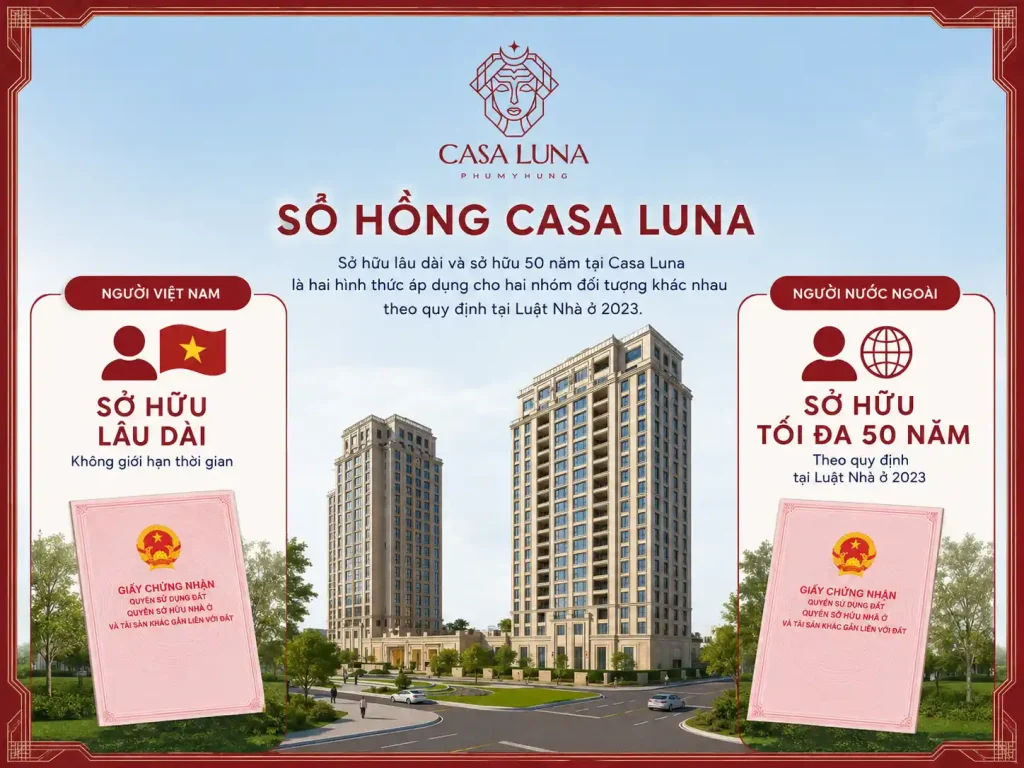
Of particular importance is that Casa Luna’s committed pink-book ownership terms differ for its 2 buyer groups: Vietnamese buyers receive pink books granting unlimited long-term ownership, while foreign buyers receive pink books granting 50-year ownership, which may be extended under the 2014 Law on Housing (as amended in 2023). This form of ownership is entirely different from and more advantageous than the 50-year pink books for condotel or holiday apartment projects, which are currently facing legal controversy in many localities.
How Does the “Pay 5% Upon Receipt of the Pink Book” Commitment Protect Casa Luna Buyers’ Interests?
The commitment to pay the final 5% only upon receipt of the pink book protects Casa Luna buyers through a financial enforcement mechanism: the developer cannot collect this final payment until the actual pink book has been handed directly to the buyer, creating the strongest financial incentive for Phú Mỹ Hưng to fulfil its legal commitments from start to finish.
More specifically, Casa Luna’s 5-instalment payment mechanism is designed so that each instalment is linked to an independent, verifiable legal milestone. The following table shows the 5-instalment payment schedule and the corresponding legal milestone that buyers can verify directly before paying each instalment:
| Instalment | Percentage | Corresponding legal milestone | Buyer protection mechanism |
| Phase 1 | 20% | Signing the Sale Contract | The notarised sale contract is a legally binding bilateral document |
| Phase 2 | 30% | In line with actual construction progress, 0% interest | The accompanying bank provides a guarantee; no payment is made before progress is achieved |
| Phase 3 | 45% | Taking handover of the apartment (expected 7/2028) | Payment is made only when the apartment is complete and an acceptance certificate has been issued |
| Phase 4 | 5% | Receiving the actual ownership certificate | Pay only when the ownership certificate bearing the buyer’s name is handed over |
| Total | 100% |
However, the most critical point does not lie in the first four phases but in the final phase (5%): this is the only point in the entire property transaction at which the buyer holds complete control. If the developer is unable to issue the actual ownership certificate, the buyer is fully entitled to refuse payment of the final 5% without breaching the contract. This is not an incidental commitment but a special clause set out by Phú Mỹ Hưng as a form of self-imposed pledge to buyers, demonstrating the highest level of confidence in Casa Luna’s ability to complete its legal documentation.
Casa Luna sales policy information: https://phumyhungcenter.com/du-an/casa-luna-phu-my-hung/chinh-sach-ban-hang-2/
How Does Casa Luna’s Legal Status Differ From Property Projects Without a Construction Permit in Ho Chi Minh City?
Casa Luna residences are entirely superior in terms of legal security, with a full construction permit, a public groundbreaking ceremony and a financially binding ownership certificate commitment. By contrast, property projects without a construction permit in Ho Chi Minh City carry at least five serious legal risks: the threat of suspension of construction, loss of the deposit, inability to obtain an ownership certificate, prolonged civil disputes and a sudden loss of asset value. This difference is not theoretical but a practical lesson drawn from numerous major property disputes in Ho Chi Minh City over the past decade.
Let us explore two important micro-niche legal aspects that are often overlooked when researching Casa Luna:
Can Foreign Investors Own a Sky Villa at Casa Luna on a Long-Term Basis Like Vietnamese Buyers?
No, foreign investors purchasing a Sky Villa at Casa Luna are not entitled to long-term ownership like Vietnamese buyers. Under Article 76 of the 2014 Housing Law (amended 2023), foreign individuals may own residential property in Vietnam for a maximum of 50 years, with one possible extension. Vietnamese citizens and overseas Vietnamese with foreign nationality are entitled to long-term ownership.
The legal cases applying to Casa Luna buyers:
- Vietnamese citizens: long-term ownership certificate with no time limit, transferable to future generations.
- Overseas Vietnamese (with verified Vietnamese origin): long-term ownership under preferential policy.
- Foreign nationals (international specialists, foreign investors): 50-year ownership, extendable once upon request.
Important note: the Housing Law caps foreign purchases at 30% of the total units in a building and 10% of the total homes in a ward. With only 49 units at Casa Luna, the quota available to foreign buyers is extremely limited. Foreign purchasers should contact the developer directly to confirm the remaining quota before placing a deposit.
Casa Luna pricing information: https://phumyhungcenter.com/du-an/casa-luna-phu-my-hung/bang-gia-2/
What Legal Risks Are Involved in Buying Into a Property Project Without a Construction Permit?
Buying into a property project without a construction permit carries at least five serious legal risks: suspension of construction by state authorities, loss of the entire deposit and progress payments, inability to obtain an ownership certificate, civil disputes lasting many years, and the risk of being forced to demolish the non-compliant structure.
The specific risks buyers face when choosing a project lacking a permit:
- Construction may be suspended at any time if building inspectors discover violations, leaving the project frozen with no resolution deadline.
- Loss of the deposit, as many contracts signed before a permit is granted have no legal validity under Article 57 of the Law on Real Estate Business.
- Inability to obtain an ownership certificate, as unlawfully constructed buildings cannot be accepted for completion or certified.
- Forced demolition in cases of serious violations, leaving the buyer stripped of both capital and property.
This is why Casa Luna’s valid construction permit is not merely a minimum requirement but a core legal advantage over many other property projects on the Ho Chi Minh City market today.
If you are interested in the Phú Mỹ Hưng Projects, please contact Phú Mỹ Hưng Center for accurate advice and the latest updates. Our experienced consultant Kim Thùy Phú Mỹ Hưng is always ready to help you choose a project suited to your residential or investment needs, while providing full information on pricing, site plans, sales policies and legal documentation.
Phumyhungcenter.com is a trustworthy website accompanying customers throughout the process of researching and transacting in Phú Mỹ Hưng projects.