The master plan of Hồng Hạc City urban area spans a total area of 197.76 hectares at the northeastern gateway of Hanoi, divided into three main sub-zones: Hồng Phát, Hồng Thịnh and Hồng Phúc, with an overall building density of just 27.9% – among the lowest in the premium urban area segment in Northern Vietnam. In particular, over 70% of the area is reserved for ecological landscaping, greenery and water features, creating a complete green city built to international standards. More importantly, this is one of the rare projects in Northern Vietnam developed by the Phu My Hung and Nomura Real Estate consortium under the All-in-One model with a century-scale planning vision.
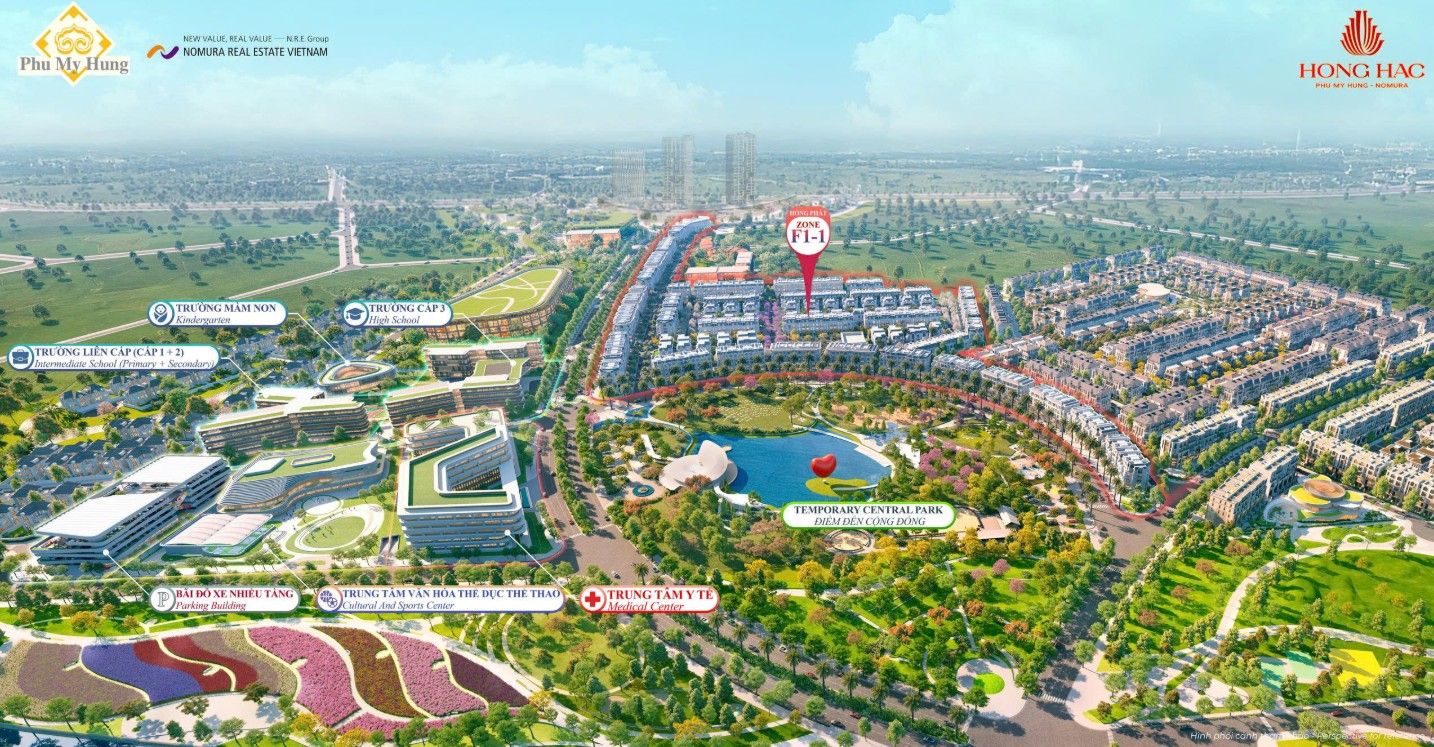
The internal amenity system at Hồng Hạc City is cohesively planned across five functional groups: education, healthcare, retail and services, sports and culture, and green landscaping, with more than 30 amenity items serving an expected population of around 27,700 people. In addition, an 18-hectare central park, seven internal clubhouses and a chain of internationally partnered schools create a complete living ecosystem within walking distance. Moreover, all underground technical infrastructure is deployed simultaneously from the initial phase, ensuring living environment quality from the very first handover.
In terms of infrastructure connectivity, Hồng Hạc City sits on the axis linking the economic triangle of Hanoi, Hải Phòng and Bắc Ninh, about 20km from Hoàn Kiếm Lake, around 2km from Ring Road 4 and roughly 16km from Gia Bình Airport. Not only that, the project directly benefits from the wave of strategic infrastructure investment in northeastern Hanoi, thereby significantly enhancing the long-term property appreciation potential for investors.
The project’s legal status was confirmed when the Bắc Ninh Provincial People’s Committee approved the investment policy in September 2024, with total investment capital of around 27,000 billion VND. Subsequently, construction is progressing on schedule, with the first home handovers expected in December 2026, giving buyers a solid foundation of confidence to commit their funds.
What Is the Overall Master Plan of Hồng Hạc City?
Hồng Hạc City is an international-standard All-in-One ecological urban area, planned across a total area of 197.76 hectares in Song Liễu Ward, Thuận Thành Town, Bắc Ninh Province, with a building density of just 27.9% and an expected population of around 27,700 people.
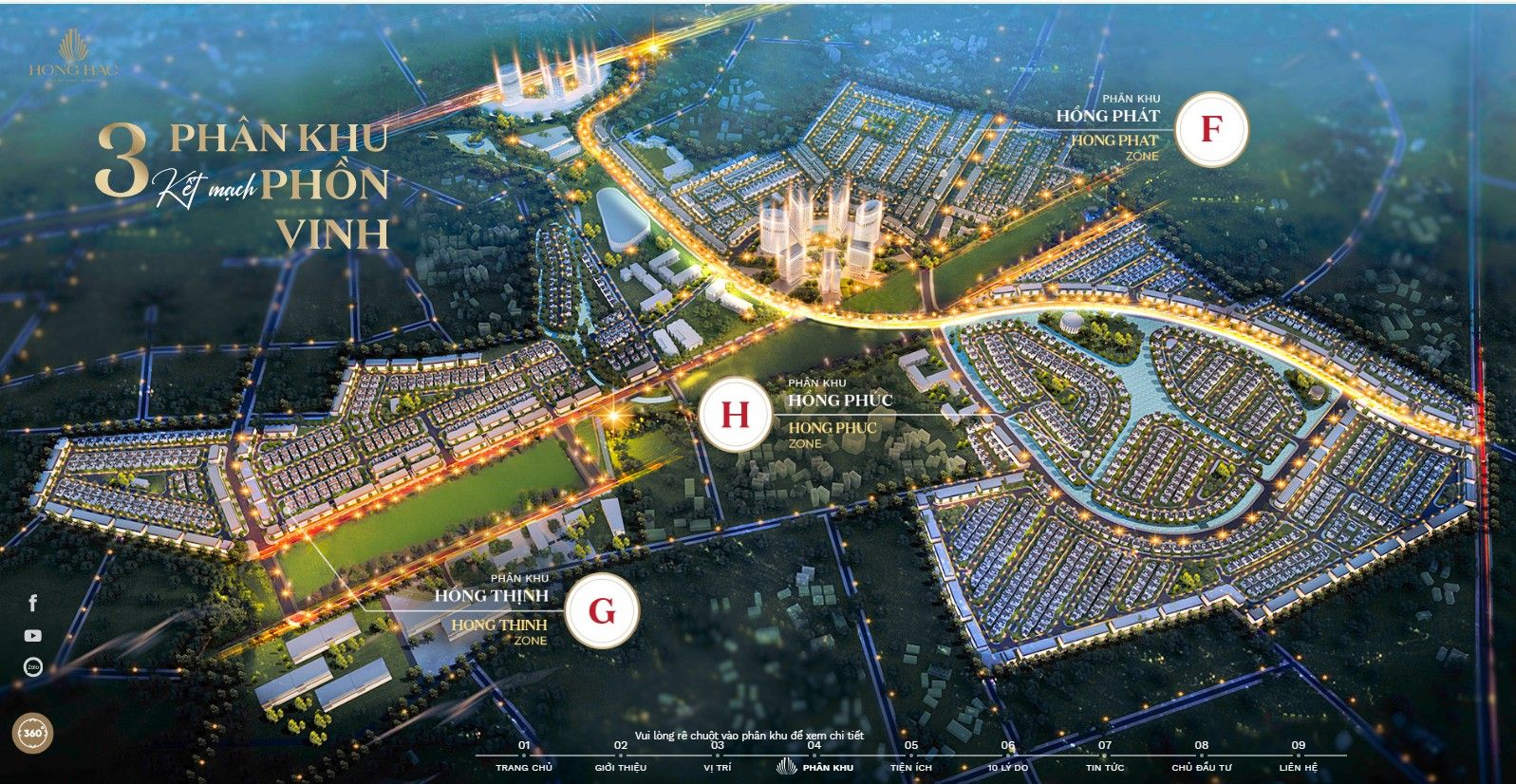
To gain a clearer understanding of this overall master plan, it is necessary to analyse in detail the land-use structure and urban design philosophy that underpin the entire project.
Hồng Hạc City is built on the principle of placing people at the centre, prioritising living space and environmental quality over building density. Within the total area of 197.76 hectares, the land-use structure is clearly allocated as follows: low-rise residential land accounts for 27.9%, equivalent to 72.1 hectares; greenery and water surface land accounts for 22.65%, equivalent to 44.96 hectares; urban transport land accounts for 25.75%, equivalent to 51.1 hectares, with more than 33km of internal roads; and internal amenity land accounts for 15.3%, equivalent to 30.37 hectares. The 27.9% building density figure is not merely a technical indicator but also a clear commitment by the developer to the quality of the living environment.
More specifically, Hồng Hạc City’s planning philosophy is distilled into the 7S principle developed by the Phu My Hung and Nomura Real Estate consortium: Sustainability, Smart Planning, Service (diverse amenities), Safety (24/7 security), Standards (legal and construction standards), Scarcity (limited-supply properties) and Society (a humane community). This planning value framework draws directly on Nomura Real Estate’s more than 70 years of global urban development experience, combined with Phu My Hung’s 30 years of urban operating experience in Vietnam.
How Many Sub-Zones Does Hồng Hạc City Have? What Does Each Sub-Zone Include?
Hồng Hạc City has three main sub-zones: Hồng Phát, Hồng Thịnh and Hồng Phúc, each designed as a self-contained residential unit with its own full range of internal amenities, while remaining seamlessly connected to the central amenity system of the entire urban area.
The Hồng Phát sub-zone was the first sub-zone launched for sale and also served as Hồng Hạc City’s market debut. In its initial phase, the Hồng Phát sub-zone introduced Zone F1-1 in 2025, followed by Zone F1-2, launched on 27 May 2026. The first sales release alone comprised 323 units in F1 Precinct, including 17 detached villas ranging from 300 to 470m², 42 semi-detached villas from 180 to 290m², 170 shophouses of 100 to 120m² built with five storeys, and 94 garden townhouses of 100 to 120m² built with four storeys. Zone F1-2 introduces a new generation of properties with a design style infused with Northern Vietnamese cultural identity, elevating the urban living experience to a new level.
The Hồng Thịnh and Hồng Phúc sub-zones will be developed in line with the project’s long-term roadmap, inheriting the full planning and design standards of the first sub-zone. Across all three sub-zones, a total of 2,844 properties will be supplied to the market, comprising detached villas, semi-detached villas, terraced houses and commercial townhouses, all built in advance and handed over fully finished.
The table of property types in the Hồng Phát sub-zone, phase 1 below summarises the type, size and number of storeys of each property category offered for sale, helping buyers quickly grasp the available options:
| Property type | Area | Number of floors | Quantity |
| Detached villa | 300 to 470m² | 3 storeys | 17 units |
| Semi-detached villa | 180 to 290m² | 3 storeys | 42 units |
| Shophouse | 100 to 120m² | 5 floors | 170 properties |
| Garden townhouse | 100 to 120m² | 4 floors | 94 properties |
Is Hồng Hạc City a Low-Density Urban Area?
Yes, Hồng Hạc City is a low-density urban area with an overall building density of just 27.9%, significantly lower than the 40 to 50% average of most urban areas in Northern Vietnam today, while over 70% of the area is devoted to landscaping and amenities.
The 27.9% building density figure has considerable practical significance for residents’ quality of life. Specifically, when building density is low, the distance between homes naturally widens, natural light and airflow circulate better, pedestrian spaces are more spacious and population density places no strain on amenity infrastructure. With greenery and water surface area reaching 44.96 hectares – equivalent to 22.65% of the total area – plus a further 30.37 hectares of internal amenity land, every resident at Hồng Hạc City enjoys green space and public amenities at a level far superior to conventional urban areas. Notably, the developer planted trees right from the initial construction phase, ensuring that when handover takes place in December 2026, residents can immediately enjoy a verdant living environment without waiting many years for the trees to mature, as is the case at many other projects.
What Types of Internal Amenities Does Hồng Hạc City Have?
There are five main amenity groups at Hồng Hạc City: education, healthcare, retail and services, sports and culture, and green landscaping, all cohesively planned under the All-in-One model with the principle that every essential need is met within walking distance.
Below is the complete amenity system planned in detail for each functional group, reflecting the vision of building a complete, self-operating living community.
How Is the Education System at Hồng Hạc City Planned?
The education system at Hồng Hạc City is planned as a closed continuum from nursery to upper secondary level, comprising four nursery schools, three primary schools and one secondary school, in direct partnership with the Hanoi Star and Quest school systems, expected to commence operations from 2028.
This is one of the biggest differentiators of Hồng Hạc City compared with other urban areas in the same segment in Bắc Ninh. More specifically, having an integrated international education model right within the urban area not only solves the schooling needs of residents’ children but also significantly enhances the property value of the entire area. The schools are designed to international standards with full playgrounds, functional classrooms and extracurricular spaces, ensuring a well-rounded development environment for children. In addition, the partnership with the Hanoi Star and Quest education systems draws on the successful school model at Phú Mỹ Hưng District 7, where the internal education system has been one of the strongest draws for residents over the past 30-plus years.
How Much of Hồng Hạc City Is Occupied by Green Space and Landscaping?
Yes, green space and landscaping at Hồng Hạc City account for more than 70% of the site’s total area, including an 18ha central park, a system of regulating lakes, green streetscapes and 7 on-site clubhouses ranging from 1,100 to 5,200m² each.
Specifically, this 70% is distributed across multiple interwoven layers of landscaping: public landscaping, comprising the 18ha central park and green routes connecting the different precincts; semi-public landscaping, comprising the clubhouses and play areas in each residential unit; and private landscaping, comprising the gardens and courtyards of individual homes. More importantly, between 2025 and 2026, the developer is implementing a range of large-scale landscape amenities, including signature photo opportunities, a weekend camping area and an outdoor children’s play area, transforming green space from a passive feature into a lively daily destination for residents. Public lighting and newly planted greenery, which are maintained regularly, will ensure that when the homes are handed over in December 2026, the green living environment will be fully ready for residents to enjoy immediately.
In addition, 3 of the 7 clubhouses have been built with areas of more than 3,000m², making them large enough to host major community activities, from residents’ meetings to cultural and artistic events, creating a strong foundation for long-term community cohesion.
Which Infrastructure Corridors Does Hồng Hạc City Connect to?
Hồng Hạc City connects to 4 key strategic infrastructure corridors: the Hanoi–Haiphong Expressway; Ring Road 4; the Gia Bình Airport connection route; and the interprovincial Bắc Ninh–Hanoi corridor, positioning the development at the heart of the Northern economic triangle.
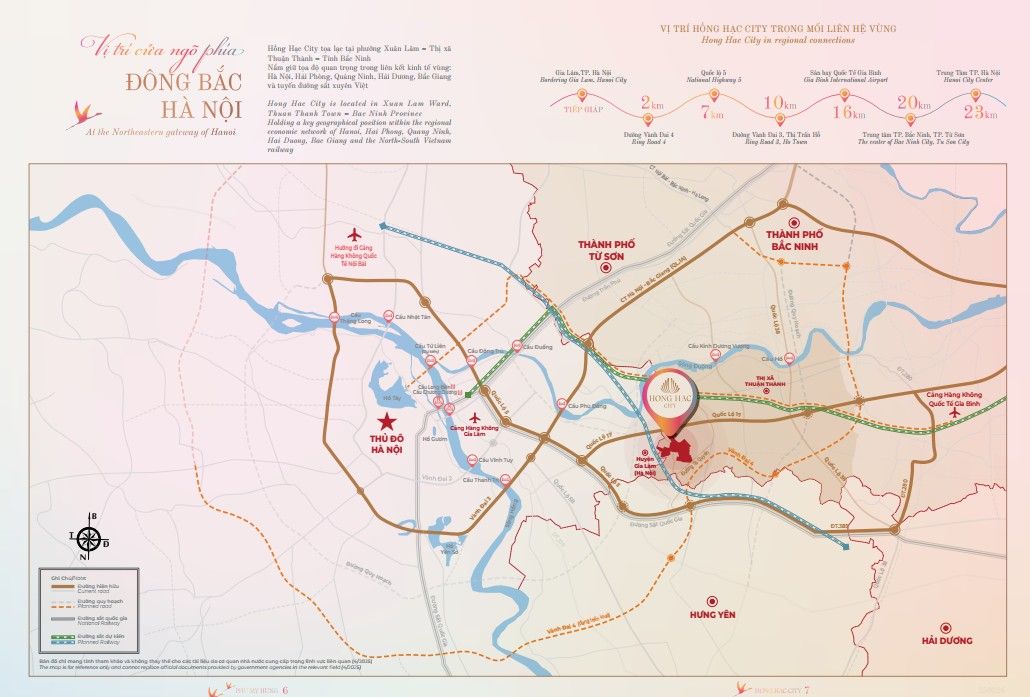
Hồng Hạc City’s geographical location is not only a transport advantage but also a long-term strategic advantage, as the area to the north-east of Hanoi enters its most intensive infrastructure investment phase to date.
The connection distance table from Hồng Hạc City to the key destinations below shows the actual convenience of travelling in each direction, helping buyers assess journey times in their daily lives:
| Destination | Distance | Main connection corridor |
| Hoàn Kiếm Lake (Hanoi) | Approximately 20km | National Highway 5, Thanh Trì Bridge |
| Ring Road 4 | Approximately 2km | Direct connection |
| Gia Bình Airport | Approximately 16km | Bắc Ninh provincial road |
| Bắc Ninh City | Approximately 20km | National Highway 38 |
| Haiphong | Approximately 80km | Hanoi–Haiphong Expressway |
Furthermore, the distance of just 2km to Ring Road 4 is a particularly notable advantage. Once completed, Ring Road 4 will connect the entire eastern ring around Hanoi, significantly reducing travel times from Thuận Thành to central Hanoi and neighbouring provinces. With Gia Bình Airport just 16km away, Hồng Hạc City residents will benefit directly when the airport becomes operational, providing convenient air connections at the gateway to the urban area. In particular, the development lies on the Hanoi–Haiphong–Bắc Ninh economic triangle, the three largest growth poles in the northern region, ensuring that housing and investment demand here will remain sustainable over time.
What Is the Current Legal Status and Construction Progress of Hồng Hạc City?
Yes, Hồng Hạc City’s investment policy was officially approved by the Bắc Ninh Provincial People’s Committee in September 2024. Construction is proceeding according to schedule, with the first homes expected to be handed over in December 2026, and total investment capital of approximately VND 27,000 billion.
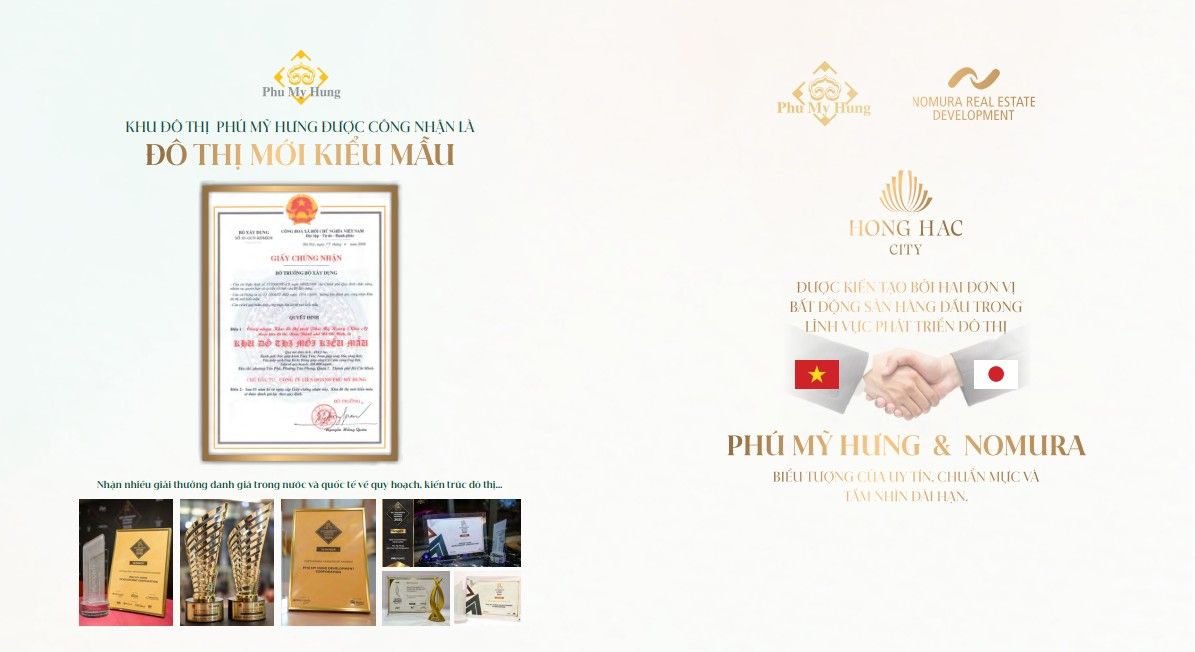
These are the three key legal and progress factors that any buyer or investor should verify before committing funds. More specifically, the approval of the investment policy by the Bắc Ninh Provincial People’s Committee at the 2024 planning announcement and investment promotion conference was the most important legal milestone, confirming that the project has a full legal basis for implementation in accordance with the current Law on Housing and Law on Real Estate Business.
In terms of construction progress, by the end of 2025, most of the main roads and side roads in the Hồng Phát precinct had been asphalted, with smooth, wide surfaces laid out according to the planned grid system. Pavements are being tiled uniformly to consistent standards, while the streets are gradually taking shape with areas for pedestrians, greenery and underground technical infrastructure. The Sales Gallery was completed and officially opened to visitors in June 2025; its carefully designed exhibition space enables customers to visualise the actual urban environment directly.
In addition, with total investment capital of VND 27,000 billion, equivalent to approximately USD 1.06 billion, Hồng Hạc City is one of the urban developments with the largest investment volumes in Bắc Ninh, reflecting the long-term commitment of both developers to the northern market. Furthermore, Phú Mỹ Hưng’s 30-year history in Vietnam, during which no project has been halted midway, is the strongest practical evidence supporting buyers’ confidence.
How Does Hồng Hạc City’s Master Plan Differ from Conventional Urban Areas in Bắc Ninh?
Hồng Hạc City excels in its exceptionally low construction density of 27.9%, while conventional urban areas in Bắc Ninh are better in terms of lower starting prices, whereas Hồng Hạc City offers greater value through higher-quality planning and sustainable value, based on the 7S philosophy and Japanese standards.
This difference is not simply a comparison of selling prices but a contrast between the planning philosophies of a high-density urban model focused on maximising the number of properties and an ecological urban model that prioritises quality of life and living space.
What Is the “All-in-One” Model at Hồng Hạc City, and Why Is It Unique?
The All-in-One model at Hồng Hạc City is an integrated urban model that brings all essential living needs together within a single site, allowing residents to walk to schools, hospitals, supermarkets, parks and sports centres without leaving the urban area.
This is the direct opposite of the “sleeping urban area” model common in Vietnam, where the sole function is to provide accommodation, while all other daily needs depend on external infrastructure. Specifically, in conventional urban areas in Bắc Ninh, good schools are usually located in town centres, hospitals are far away and commercial areas have yet to be established, leaving residents entirely dependent on travel. By contrast, Hồng Hạc City includes 4 preschools, 3 primary schools, 2 medical stations, a medical centre of more than 11,000m², a commercial and services centre and 7 clubhouses within the site, creating a community that is self-sufficient in terms of everyday amenities.
How Will Hồng Hạc City’s Planning Affect Property Values in the Thuận Thành Area?
Hồng Hạc City’s planning will have a positive impact on property values in Thuận Thành in 3 main ways: creating strong demand for homes from a high-quality population moving into the area; triggering investment in infrastructure and services in the surrounding buffer zone; and establishing a new price level across the Thuận Thành property market.
The precedent of Phú Mỹ Hưng in District 7 is the clearest evidence. Before Phú Mỹ Hưng was developed, southern Hồ Chí Minh City was an overlooked property market. After 30 years, the entire southern area has become the city’s most vibrant urban region, with property prices increasing dozens of times. In addition, with VND 27,000 billion in total investment directed into a township-level area, pressure for land prices to rise in the buffer zone surrounding Hồng Hạc City is a highly predictable trend for medium- and long-term investors.