Hong Hac City has 5 outstanding advantages, including its strategic location at Hanoi’s north-eastern gateway, reputable developer Phu My Hung with nearly 30 years of experience, a Japanese-standard All-in-One masterplan, complete legal documentation with more than 1,000 properties holding ownership certificates, and a building density of just 27.9%, the lowest in the Bac Ninh area. In particular, the combination of Phu My Hung and Nomura Real Estate Vietnam creates an unprecedented quality foundation in the northern real estate market. More importantly, these advantages provide a foundation for sustainable long-term price growth for investors.
Alongside its advantages, Hong Hac City also carries potential risks that investors should carefully consider before committing funds: the starting price of 125–160 million/m² is higher than the area average, handover is scheduled to continue until early 2027, and the limited release schedule of only 300–500 properties per year means that secondary-market liquidity has not yet developed. Furthermore, buyers need sufficient long-term financial capacity to withstand a 3- to 5-year holding period before the market reflects the property’s true value.
Yes, buying Hong Hac City during the initial phase is advisable because prices are still at their lowest starting level across the project’s lifecycle, which runs until 2036. It is particularly suitable for two groups: families buying for their own occupation and long-term investors expecting price growth driven by Gia Binh Airport and Ring Road 4 infrastructure. However, the project is not suitable for short-term investors requiring quick liquidity or buyers with limited budgets.
To understand each of the above points more clearly, the following article analyses the advantages and risks in detail and provides specific recommendations to help you make the most informed investment decision.
What Are the Outstanding Advantages of Hong Hac City?
Hong Hac City has 5 outstanding advantages according to the 5 most important criteria in property assessment: geographical location, developer capability, planning quality, transparent legal status, and integrated amenities within walking distance.
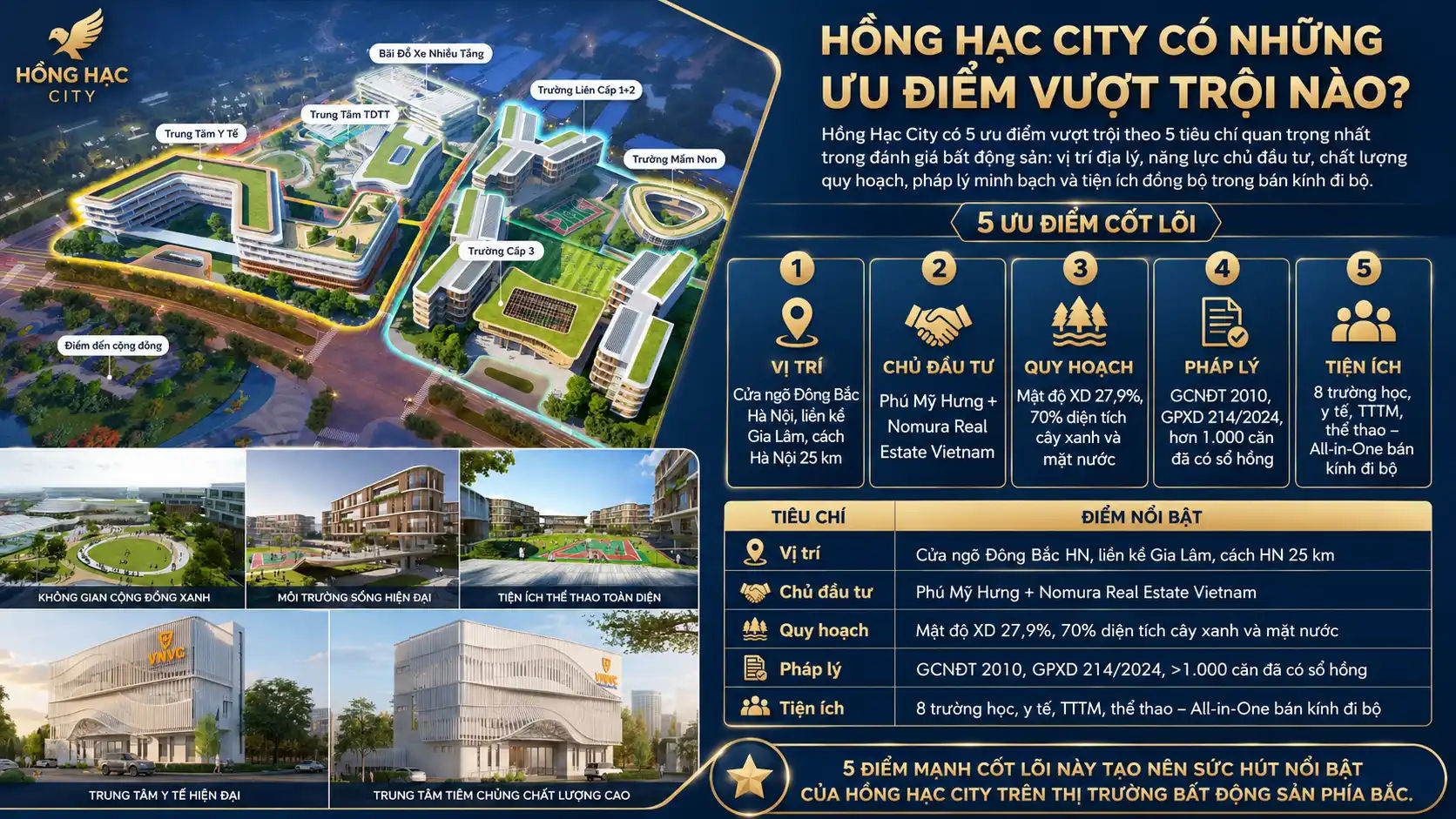
Specifically, before examining each advantage in depth, here is a summary table of the 5 core strengths that make Hong Hac City attractive in the northern real estate market (an overview table describing Hong Hac City’s 5 advantages according to standard property-assessment criteria, enabling readers to grasp them quickly before reading the details):
| Criteria | Key features |
| Location | Hanoi’s north-eastern gateway, next to Gia Lam, 25 km from Hanoi |
| Developer | Phu My Hung + Nomura Real Estate Vietnam |
| Master planning | 27.9% building density, with 70% of the area devoted to greenery and water features |
| Legal status | 2010 Investment Registration Certificate, Construction Permit 214/2024, and more than 1,000 properties holding ownership certificates |
| Amenities | 8 schools, healthcare, a shopping centre and sports facilities — an All-in-One development within walking distance |
Below is a detailed analysis of each advantage, in order of importance for the investment decision.
What Advantages Does Hong Hac City’s Strategic Location Offer Investors?
Hong Hac City’s location provides 4 direct regional connectivity advantages: proximity to central Hanoi (25 km), adjacency to Gia Lam, a position on the Hanoi–Hai Phong–Bac Ninh economic corridor, and direct benefits from the Gia Binh Airport project currently under development.
Specifically, the project is located in Xuan Lam Commune, Thuan Thanh District, Bac Ninh Province, directly at Hanoi’s north-eastern gateway. From here, residents can travel quickly to key destinations via a multi-tiered transport network comprising National Highway 17, National Highway 5, Ring Road 4 and the airport access road to Gia Binh, which is under development. In particular, the road connecting Gia Binh Airport with central Hanoi has been identified as the most important infrastructure catalyst for the Thuan Thanh area, with the potential to reduce journey times to under 30 minutes and generate a significant increase in property prices between 2026 and 2030.
Furthermore, Bac Ninh’s position as the North’s FDI industrial capital, with Samsung, Canon, LG and hundreds of Japanese and South Korean companies, creates consistently high demand for quality housing from foreign experts and engineers. More importantly, Bac Ninh is aiming to become a centrally governed city, a major macroeconomic factor shaping the wave of property price growth across the region over the next 5 to 10 years.
How Do Developers Phu My Hung and Nomura Ensure the Quality of Hong Hac City?
Developer Phu My Hung, which holds 99.68% of the shares, has joined forces with strategic partner Nomura Real Estate Vietnam to create a dual-standard urban development model: Phu My Hung’s 30 years of experience and reputation in Vietnam combined with the international standards of Japan’s leading real estate group.
Specifically, Phu My Hung has demonstrated its ability to develop sustainable urban areas through nearly 30 years of operating Phu My Hung Urban Area in District 7, Ho Chi Minh City, one of the most highly regarded urban areas in Vietnam for planning quality, integrated infrastructure and continually increasing asset values. As a result, the developer has accumulated a system of processes, construction standards and urban operations-management expertise essential for developing a 197.76-hectare project in Bac Ninh.
In particular, Nomura Real Estate Vietnam’s involvement brings not only capital and brand credibility but also internationally recognised planning and legal standards. This is why all 1,047 properties in the Hong Phat subdivision have been transparently issued ownership certificates — an impressive figure that is rare among new urban areas of a comparable scale in Bac Ninh. In addition, the building density of just 27.9%, with 70% of the area allocated to greenery and water features, is the clearest expression of the Japanese planning philosophy: prioritising real quality of life rather than maximising the number of properties.
What Potential Risks of Hong Hac City Should Investors Note?
Hong Hac City has 3 principal potential risks that investors should consider in order of impact: a price level high compared with the local market, handover extending until 2027, and secondary-market liquidity that has not yet developed.
Specifically, these are real risks, not unfounded concerns, and viewing them objectively will help investors make a decision suited to their risk appetite and financial capacity. Below is a detailed analysis of each risk, together with its actual level of impact.
Does Hong Hac City’s Price of 125–160 Million/m² Accurately Reflect Its Real Value?
Hong Hac City’s price of 125–160 million/m² is 30–50% higher than that of comparable townhouses and villas in the Thuận Thành, Bac Ninh area, reflecting the Phu My Hung brand premium and quality standards above the market average.
Specifically, investors need to understand that Hong Hac City’s pricing comprises 3 layers of value: the value of the area’s land (lower than Hanoi but rising rapidly due to infrastructure), a premium for planning and construction quality (27.9% building density and All-in-One amenities), and a Phu My Hung brand premium. However, the risk is that when the market corrects or liquidity declines, the brand premium may narrow before the underlying land value becomes sufficient to compensate for it.
Furthermore, investors wishing to buy for short-term rental or expecting price growth within 1–2 years should exercise caution, because high capital costs and an insufficiently deep secondary market may make it unable to absorb the number of properties offered for resale. More importantly, this is not a risk specific to Hong Hac City but a common characteristic of all high-end off-plan developments: their value is fully recognised only after the project is completed and a resident community has formed.
What Risks Are Created by Hong Hac City’s Handover Schedule and Limited Release Programme?
With handover expected from January 2027 and a sales schedule of only 300-500 homes per year from 2025 to 2036, two direct risks arise: buyers must bear the opportunity cost of their capital during the waiting period, and the secondary market lacks liquidity as new supply is continuously released at higher prices.
Specifically, with a development cycle extending to 2036, buyers at the current stage need to define their capital plan clearly: if borrowing 70% of the property value from a bank (equivalent to VND 3-5 billion depending on the unit type), interest costs during the 2025-2027 construction period will be a real expense incurred even with an interest grace period. However, this is also precisely Phu My Hung’s intelligent supply-control mechanism: not releasing stock en masse helps maintain stable prices across each phase.
In addition, secondary-market liquidity risk is the most important point to note: when early-phase buyers want to resell before handover (contract assignment), there are few reference transactions on the secondary market in the Thuan Thanh area, so negotiated prices depend more on sentiment than on actual market data. Investors need to be prepared to hold the property at least until handover to have sufficient basis for accurate asset valuation.
Should You Buy Hong Hac City?
Yes, you should buy Hong Hac City for three core reasons: this is the lowest entry-price stage in the project’s lifecycle, which runs until 2036; developer Phu My Hung has proven its delivery capability at Phu My Hung District 7, Ho Chi Minh City; and north-east Hanoi’s regional infrastructure is entering its strongest investment cycle in history.
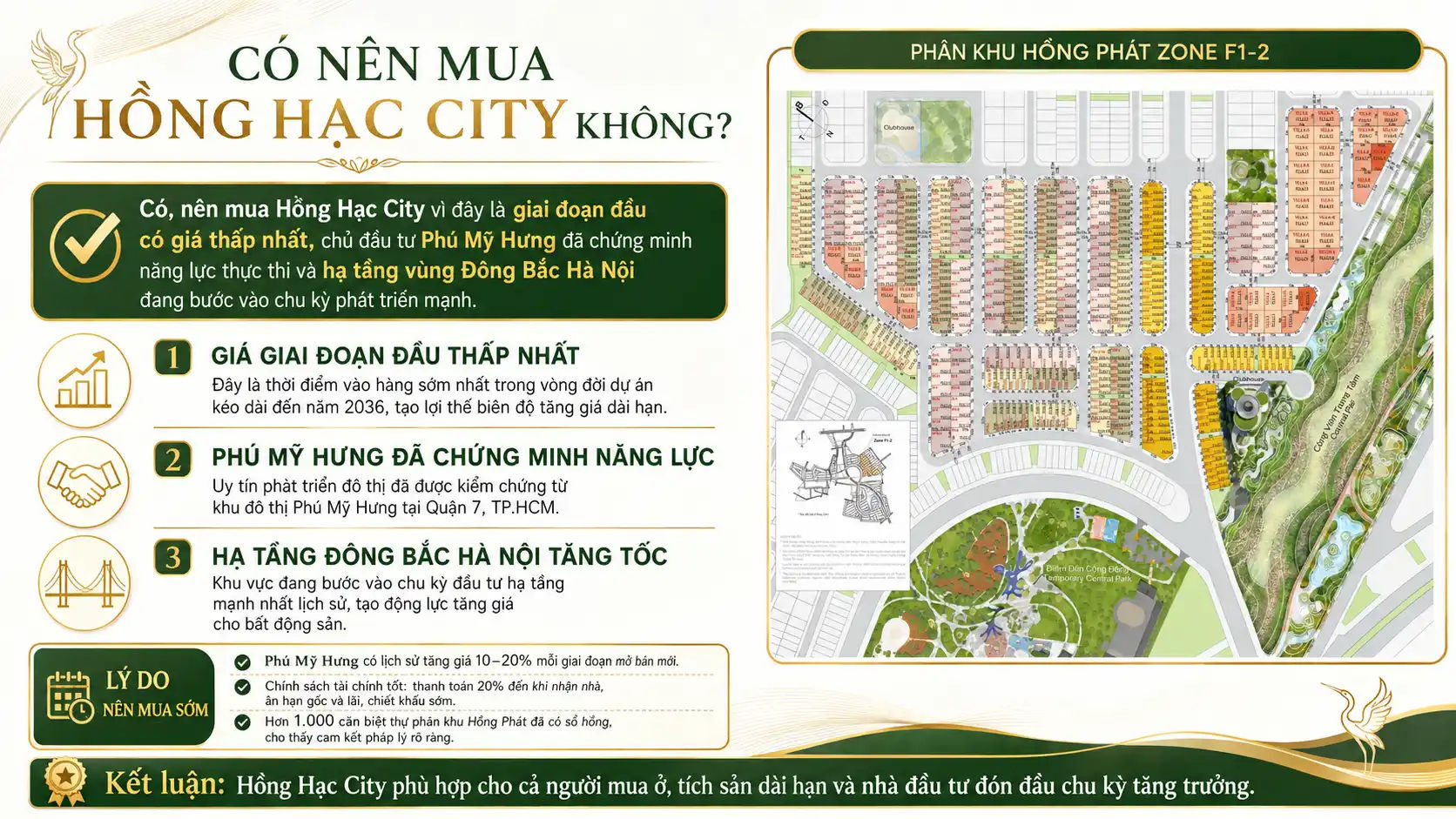
Specifically, the most important reason to buy early is Phu My Hung’s escalating price structure: the group has a history of raising prices by 10-20% at each new sales phase, based on a philosophy of controlled scarcity (only 300-500 homes per year). In addition, the early phase always comes with the best financial policies: 20% payment until handover, principal and interest grace periods, and early-bird discounts. Notably, the fact that more than 1,000 villas in the Hong Phat sub-zone already have their pink books is the most vivid proof that Phu My Hung fulfils its legal commitments, a rare factor in the current Bac Ninh property market.
However, the answer to “should you buy” is not the same for everyone. Below is a detailed analysis by buyer group and optimal timing.
Which Customer Groups Are Best Suited to Hong Hac City?
Hong Hac City is best suited to two main customer groups by purpose of use: owner-occupiers seeking a prestigious living environment, and long-term investors expecting price growth from regional infrastructure; it is not suitable for short-term investors needing quick liquidity.
Group 1 – Genuine owner-occupiers are the best fit for Hong Hac City for the following reasons:
- Families with children benefit directly from a system of 8 schools within walking distance (nursery to upper secondary)
- Families who prioritise green living: 70% of the area is greenery and water features, with low building density
- Families with stable incomes, ready to wait for handover in early 2027 and able to tolerate the time it takes for a resident community to form
Group 2 – Long-term investors (5 years or more) are suited to Hong Hac City when:
- They expect price growth from Gia Binh Airport (~15km from the project), Ring Road 4 and Bac Ninh’s upgrade to a centrally governed city
- They plan to let the property long term to FDI experts from Samsung, Canon, LG and neighbouring industrial parks
- They do not rely on short-term liquidity from this asset
Unsuitable groups should think carefully before deciding:
- Short-term speculators (under 2 years): the secondary market has not yet formed, making it hard to exit quickly at the desired price
- Those on a limited budget: a minimum of VND 5-7 billion is required (20% of the contract value plus incidental costs)
- Those who need a home immediately: the project will not be handed over until early 2027
When Is the Ideal Time to Invest in Hong Hac City?
The ideal time to buy Hong Hac City is right now, in the current early phase, as this is the lowest starting price in the project’s entire lifecycle from 2025 to 2036, together with the most preferential financial policies from the developer, which apply only to early buyers.
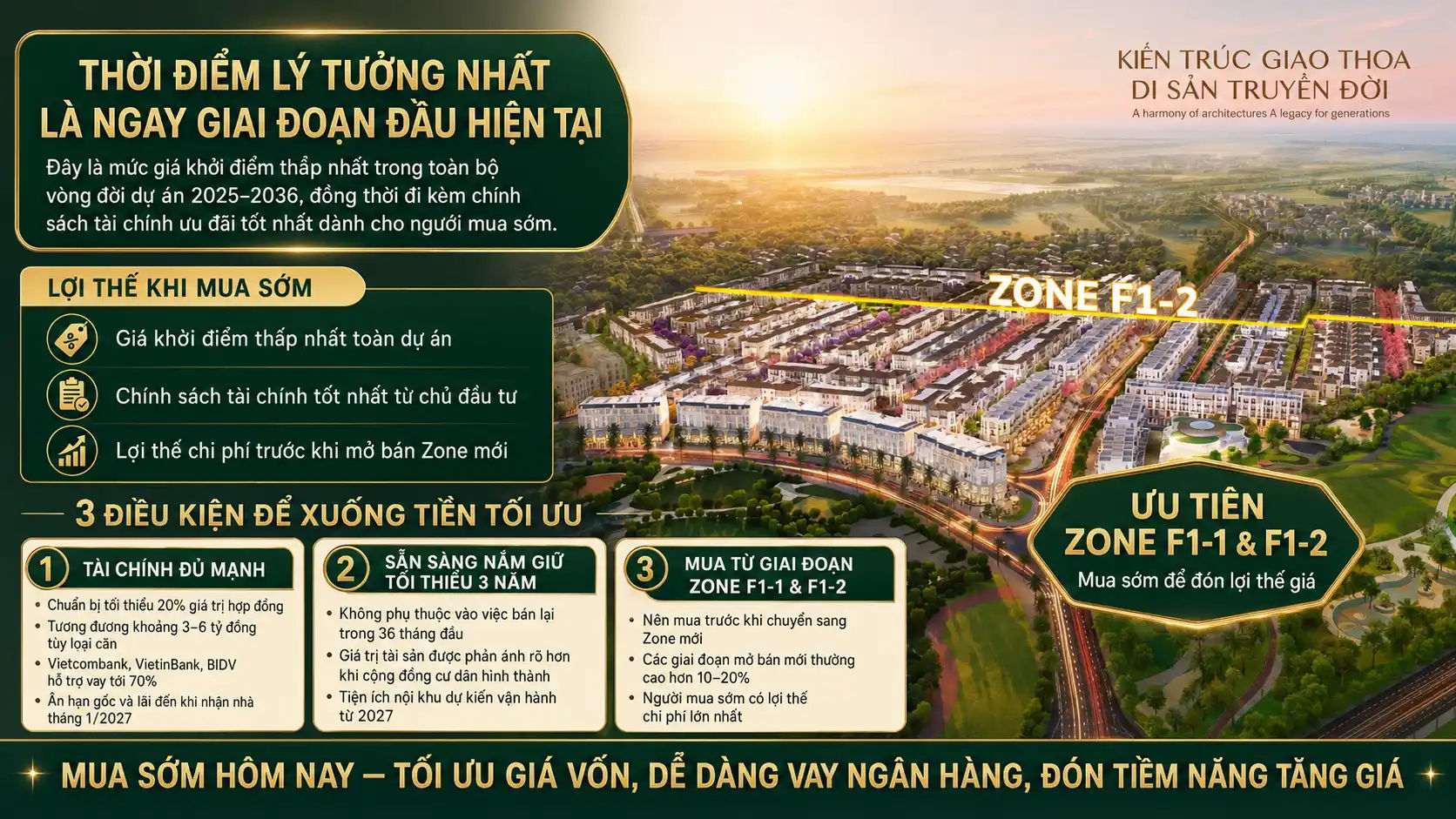
Specifically, investors can commit funds optimally when they meet all 3 of the following conditions:
Condition 1: Finances strong enough to enter at the early stage Buyers need to prepare at least 20% of the contract value (from VND 3 to 6 billion depending on unit type) to sign the sale and purchase agreement and set up a flexible payment schedule. Vietcombank, Vietinbank and BIDV currently offer 70% loans with principal and interest grace periods until handover in January 2027.
Condition 2: Willingness to hold for a minimum of 3 years Buyers need a financial plan that does not depend on reselling this property within the first 36 months. Only once the resident community has formed and the internal amenities are operational (expected from 2027) will the asset’s value be fully reflected on the secondary market.
Condition 3: Buy during Zones F1-1 and F1-2 before the project moves to a new zone Phu My Hung’s pricing history shows that each new sales phase is typically priced 10-20% higher than the previous one, so the earliest buyers always enjoy the greatest cost advantage when benchmarked against the later secondary market.
How Does Hong Hac City Differ from Comparable Projects in Bac Ninh?
Hong Hac City outperforms comparable projects in Bac Ninh in terms of planning quality and developer capability, while local projects have the advantage of lower prices and an earlier-forming secondary market.
However, to better understand Hong Hac City’s competitive positioning within the market landscape, consider the two important comparison angles below.
How Does Hong Hac City Differ from Phu My Hung Urban Area, District 7, Ho Chi Minh City?
Hong Hac City inherits the sustainable planning philosophy of Phu My Hung District 7 but serves a completely different market and economic context: District 7 took 30 years to fully establish its community and amenities, while Hong Hac City is at the starting stage with higher growth potential but also greater execution risk. Similarities: low density, prioritised green space, All-in-One amenities and a commitment to legal transparency. Differences: the scale of the target market, regional connectivity infrastructure and the economic contexts of north-east Hanoi versus Ho Chi Minh City create two price-appreciation journeys with distinct characteristics.
How Is the Rental Yield at Hong Hac City Assessed?
The rental yield at Hong Hac City is estimated at 3-5% per annum, based on rental demand from FDI experts and engineers at the Samsung, Canon and LG industrial parks concentrated in Bac Ninh and neighbouring provinces. Specifically, a semi-detached villa worth around VND 15-20 billion can be let for VND 40-70 million per month to Japanese or Korean experts, equivalent to a rental yield of 2.4-4.2% per annum. This is lower than current short-term deposit rates but higher than villas in the same segment in Hanoi’s outlying districts, and more importantly it is supplemented by sustainable long-term capital appreciation potential as regional infrastructure is completed.